- Stop using a door that is jammed, visibly damaged or moving differently in a way that raises concern. Keep people clear and obtain qualified service; an injured or trapped person requires emergency help.
- The door, guidance and counterbalance, powered drive, controls and protective functions have different roles. A working remote, light or closing cycle does not establish all of them.
- Match the actual door and opener identities to their instructions, retain the existing symptom account and ask what service and checks actually included. Pictures and records cannot provide remote operating clearance.
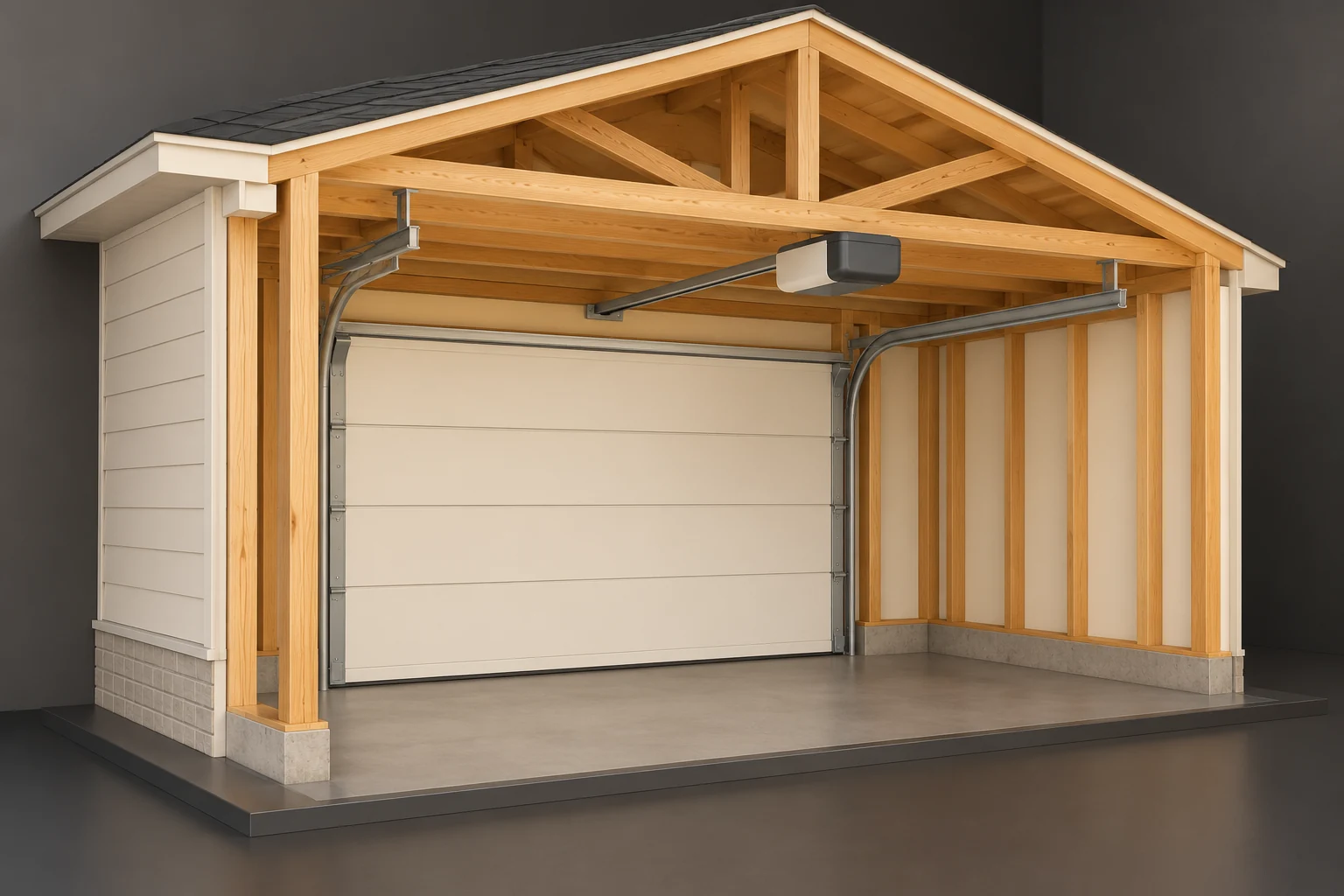
A closed segmented door fills the opening. Side guides curve into upper horizontal forms; a separate-looking overhead rail and closed housing sit above the empty floor. Timber frame and cream wall faces establish the room context.
About this illustration
Counterbalance springs, cables, protective devices and actual working connections are not established. No model, attachment capacity, balance, setting, electrical arrangement or operating result is shown. This is not an installation or service detail. This is a conceptual teaching model, not an assessment of your home.
7 picture lessons appear beside the questions in this guide. Use them to understand the explanation, then consider what it means for your home.
When does changed operation mean stop using the door?
A garage door is a heavy moving assembly. Keep people, pets and belongings clear, keep ordinary operation in sight, and never cross its moving path or stand beneath a partly open door. If it jams, looks displaced, shows damage or suddenly moves differently, stop using it and arrange qualified door-system service. Do not repeat commands to see whether the symptom disappears. If someone is trapped or injured, contact emergency services rather than attempting a spring, cable or opener repair. Manufacturer warnings address both moving parts and stored spring tension.
This guide explains how to frame the service question after immediate safety is addressed. It does not remotely clear a door for use. The historical PHAC garage-door brief describes injuries involving closing or falling doors, panel pinch points, mechanisms and repairs. Its 1990–2005 sentinel-hospital data are not a current national risk estimate. The useful lesson is to keep observation separate from exposing a person to movement. An account of what already happened can help a technician; another cycle, a hand in a joint or an improvised release is not needed to make that account useful.
What belongs to the door, and what belongs to the opener?
Start with four roles. The door sections form the barrier across the opening. Hinges, rollers and tracks guide that barrier along a defined route. A counterbalance arrangement offsets the door’s weight through its identified spring and associated hardware. The opener supplies powered movement through its own drive and connection to the door. Controls request operation, while the identified protective functions can affect the response. These roles interact, but they are not interchangeable. A new motor unit does not establish the condition of the retained door hardware.
The main mechanism here is a residential sectional overhead door with a separate opener, illustrated by GARAGA door documents and the named Canadian-market Chamberlain belt-drive manual. Other door forms, low-headroom arrangements, wall-mounted operators and shared garage systems need their own documents. Identify the installed door as well as the opener; “the garage system” is too broad for a replacement invoice. Ask what was replaced, retained and checked. The conceptual cutaway introduces component locations. It cannot reveal the counterbalance, protective connections, attachment strength, model or an actual operating result.
The moving door and overhead drive do different jobs
A closed segmented door fills the opening. Side guides curve into upper horizontal forms; a separate-looking overhead rail and closed housing sit above the empty floor. Timber frame and cream wall faces establish the room context.
Numbers identify the parts explained below.
- Closed door assembly
Sections form the moving barrier. Their appearance cannot establish weight, balance, condition or suitable hardware.
- Guide landmarks
Side and upper shapes introduce the door’s travel path. The illustration cannot establish alignment, attachment or a functioning roller-and-track system.
- Overhead drive landmark
The housing and rail introduce a separate drive question. No actual opener model, connection, force setting or protective function is identified.
What does this illustration leave out?
Counterbalance springs, cables, protective devices and actual working connections are not established. No model, attachment capacity, balance, setting, electrical arrangement or operating result is shown. This is not an installation or service detail. This illustration explains an idea. It is not an installation guide.
Which actual door, guidance/counterbalance arrangement and opener functions explain the changed normal operation?
Explore this with HomeAI ↗Opens an editable question. Nothing is sent until you choose to send it.A stronger opener does not answer every door question.
These connected roles explain the system. They are not an energy-flow drawing, installation detail or checking procedure.
- Moving door and guidanceSections form the moving barrier; hinges, rollers and tracks guide its changing position. Their installed condition and support remain physical door-system questions.
- CounterbalanceThe actual spring arrangement helps support and balance the door. Stored energy and the associated hardware require qualified door-system service; no spring, cable or release action is illustrated here.
- Powered driveThe matched opener provides controlled movement to a suitable, properly balanced door. It does not establish that the door or its supports are in good condition.
- Commands and protective functionsA command requests movement. Identified protective functions respond to their specified inputs. A working remote or one completed movement cannot prove all protective functions.
No force value, counterbalance setting, connection design, obstruction experiment or passing test is established. A changed or damaged door needs the appropriate service scope before further operation.
Manufacturer explanation sources: GARAGA · Residential garage door installation manual, 95847 / 01-2026 (January 2026, Canadian residential-door context) and Chamberlain · B2202C / B2405C / B4505TC belt-drive opener manual. The identified manuals apply to their actual products, not every Canadian installation. Read October 4, 2026 (UTC).
How do sections, rollers and tracks guide the movement?
A sectional door changes orientation as it moves from the upright opening toward the overhead position. Hinged joins let adjacent sections change their relative angle. Rollers at the edges follow the track route, including its curved transition. The vertical, curved and horizontal portions therefore answer different parts of the travel question. Supporting brackets and hangers belong to the arrangement too: a drawn track line is not evidence that the real support is suitable. GARAGA documents several configurations, so one photograph should not be treated as the universal layout.
A new scrape or uneven-looking motion could involve guidance, a section, a connection or another part of the door system. It does not identify which component should be moved. Describe the location and whether the existing account concerned opening, closing or a particular point in travel. From a safe stationary position, an accessible photograph may show visible damage without proving alignment or capacity. Do not touch a track, hinge, roller, bracket or fastener to test the explanation. Panel joins and moving hardware are precisely the places where keeping hands clear matters.
The moving door and overhead drive do different jobs
A closed segmented door fills the opening. Side guides curve into upper horizontal forms; a separate-looking overhead rail and closed housing sit above the empty floor. Timber frame and cream wall faces establish the room context.
Numbers identify the parts explained below.
- Closed door assembly
Sections form the moving barrier. Their appearance cannot establish weight, balance, condition or suitable hardware.
- Guide landmarks
Side and upper shapes introduce the door’s travel path. The illustration cannot establish alignment, attachment or a functioning roller-and-track system.
- Overhead drive landmark
The housing and rail introduce a separate drive question. No actual opener model, connection, force setting or protective function is identified.
What does this illustration leave out?
Counterbalance springs, cables, protective devices and actual working connections are not established. No model, attachment capacity, balance, setting, electrical arrangement or operating result is shown. This is not an installation or service detail. This illustration explains an idea. It is not an installation guide.
Which actual door, guidance/counterbalance arrangement and opener functions explain the changed normal operation?
Explore this with HomeAI ↗Opens an editable question. Nothing is sent until you choose to send it.What does the counterbalance system do?
Counterbalance changes the effort needed to move the door by offsetting its weight. GARAGA describes torsion and extension spring arrangements with different associated hardware. In a torsion arrangement, a spring and shaft/drum/cable system participates in this task; an extension arrangement has a different spring and pulley relationship. The mechanism involves stored energy, not just an extra visible piece beside the track. Door weight, hardware and configuration belong to the actual matched system. The same-looking spring in an online picture does not identify a replacement.
A door that becomes unusually difficult to move or behaves differently may need counterbalance assessment, but a symptom alone does not prove a broken spring. Guidance, cables, attachments and other conditions can be involved. The Chamberlain manual directs binding, sticking or out-of-balance door questions to a trained door-systems technician before opener work. Do not disconnect the drive to create a household lifting or balance demonstration. Spring, cable, drum and attached-bracket work stays with qualified service. Ask the provider to explain the assessed arrangement and finding rather than supplying a tension value or adjustment instruction here.
The moving door and overhead drive do different jobs
A closed segmented door fills the opening. Side guides curve into upper horizontal forms; a separate-looking overhead rail and closed housing sit above the empty floor. Timber frame and cream wall faces establish the room context.
Numbers identify the parts explained below.
- Closed door assembly
Sections form the moving barrier. Their appearance cannot establish weight, balance, condition or suitable hardware.
- Guide landmarks
Side and upper shapes introduce the door’s travel path. The illustration cannot establish alignment, attachment or a functioning roller-and-track system.
- Overhead drive landmark
The housing and rail introduce a separate drive question. No actual opener model, connection, force setting or protective function is identified.
What does this illustration leave out?
Counterbalance springs, cables, protective devices and actual working connections are not established. No model, attachment capacity, balance, setting, electrical arrangement or operating result is shown. This is not an installation or service detail. This illustration explains an idea. It is not an installation guide.
Which actual door, guidance/counterbalance arrangement and opener functions explain the changed normal operation?
Explore this with HomeAI ↗Opens an editable question. Nothing is sent until you choose to send it.How does the opener move an already supported door?
In the identified Chamberlain belt-drive example, a motorized unit drives a belt/trolley arrangement along a rail, and an arm transfers movement to the door connection. The opener mounting and the door attachment each have their own support question. This is a drive concept, not a drawing of the correct fixings for your garage. A wall-mounted operator or another drive type uses a different arrangement. Match the real model and installed configuration before transferring an explanation, accessory claim or service instruction from this example.
The drive needs a suitable functioning door; it is not a substitute for guidance or counterbalance. Increasing force to overcome difficult travel or a tight bottom seal can obscure the actual question and is not an owner remedy supplied here. GARAGA specifically warns against increasing opener pressure to crush the seal. If the door or its finish was replaced while the opener stayed, ask whether the retained drive and connection were included in the handover assessment. A photograph of a closed housing, a running light or a motor sound establishes none of those findings.
Identify the actual parts before interpreting a signal
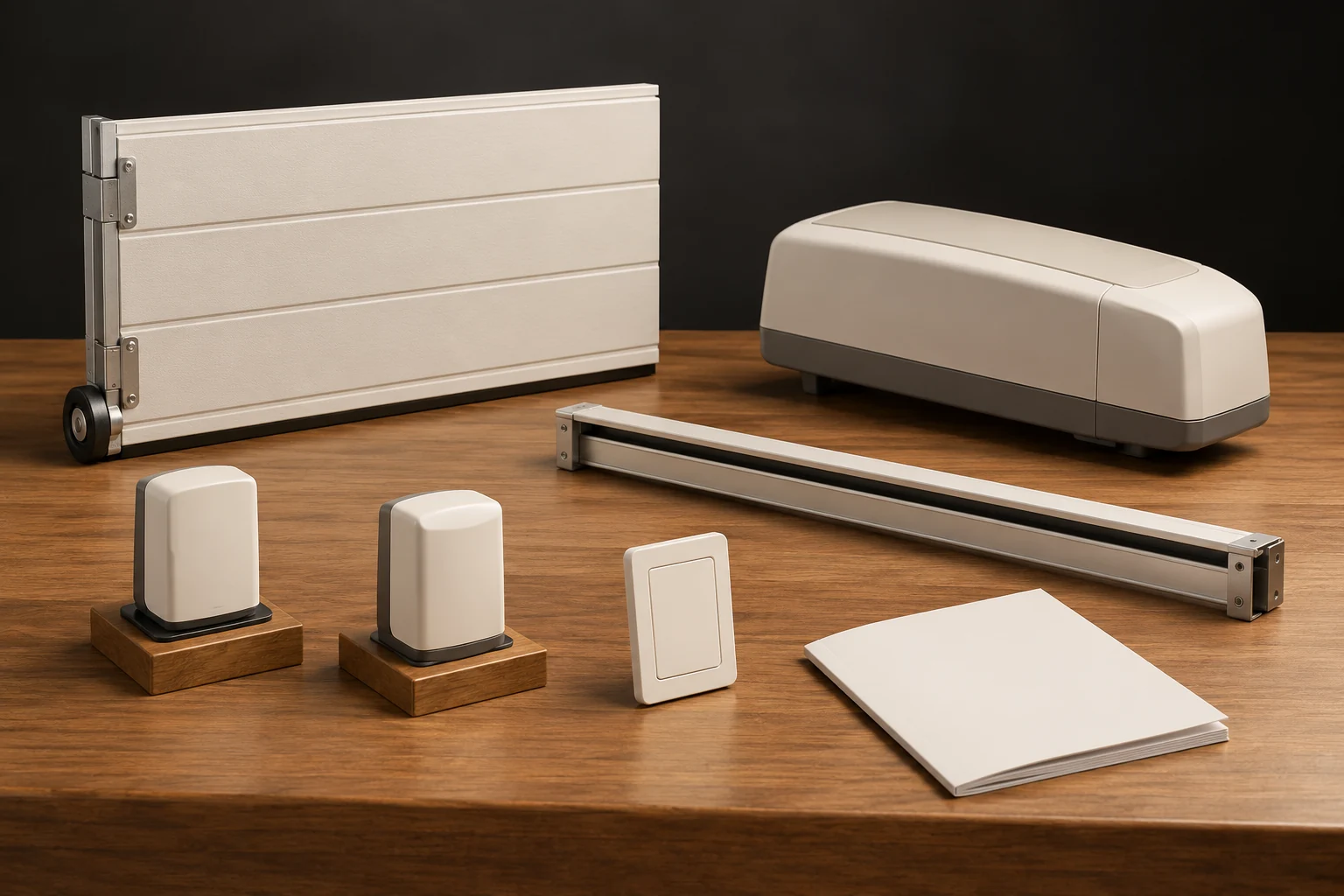
The panel specimen has hinge-like joins and a roller-like wheel. A closed housing and straight rail sit separately. Two small matching blank forms, a control-like rectangle and a blank booklet complete the comparison.
Numbers identify the parts explained below.
- Panel and guidance specimen
Distinguish the physical moving-door question from the command sent to an opener. The separate specimen supplies no balance or condition result.
- Housing and rail specimens
Match the installed opener’s actual identity and instructions. Appearance cannot establish drive type, compatible door, settings or completed installation.
- Plain devices and blank instructions
Identify the real protective/control functions and their specified checks. Blank forms and paper contain no signal interpretation, maintenance interval or completed test.
What does this illustration leave out?
The separate forms identify no brand, model, sensing method, compatibility, alignment, interconnection or test outcome. A control-like face cannot establish an opener control. Nothing depicts an operational assembly, spring/cable procedure or obstruction test. This illustration explains an idea. It is not an installation guide.
What do the exact model instructions say about this signal and protective function, and what did the service actually assess?
Explore this with HomeAI ↗Opens an editable question. Nothing is sent until you choose to send it.Why are controls and protective functions separate?
A wall control, remote, keypad or connected app can send a command. Sending the command does not establish that the route is clear. In the named opener manual, opposing photoelectric devices create a beam; interruption during closing affects stopping and reversal. Contact-reversal behavior is a different described function. Neither role turns the opener into a room-wide occupancy detector. The photoelectric response in this example does not protect the opening cycle in the same way. Learn the identified functions without placing a person or object in the moving path to explore them.
Control features also vary. A motion-responsive light feature on an identified control is not an entrapment-protection feature, and a remote-inhibit setting is distinct from a physical door lock. Health Canada’s 2023 RA-72666 recall concerned specified control panels paired with a specified type of operator and an exterior keypad; it illustrates why combinations matter. It does not say every opener is affected. Check actual identities against current recall and manufacturer advice and contact the manufacturer about a match. Do not reproduce an override sequence or assume a different accessory resolves protection.
Identify the actual parts before interpreting a signal
The panel specimen has hinge-like joins and a roller-like wheel. A closed housing and straight rail sit separately. Two small matching blank forms, a control-like rectangle and a blank booklet complete the comparison.
Numbers identify the parts explained below.
- Panel and guidance specimen
Distinguish the physical moving-door question from the command sent to an opener. The separate specimen supplies no balance or condition result.
- Housing and rail specimens
Match the installed opener’s actual identity and instructions. Appearance cannot establish drive type, compatible door, settings or completed installation.
- Plain devices and blank instructions
Identify the real protective/control functions and their specified checks. Blank forms and paper contain no signal interpretation, maintenance interval or completed test.
What does this illustration leave out?
The separate forms identify no brand, model, sensing method, compatibility, alignment, interconnection or test outcome. A control-like face cannot establish an opener control. Nothing depicts an operational assembly, spring/cable procedure or obstruction test. This illustration explains an idea. It is not an installation guide.
What do the exact model instructions say about this signal and protective function, and what did the service actually assess?
Explore this with HomeAI ↗Opens an editable question. Nothing is sent until you choose to send it.What can lights, reversals and a failed command tell me?
Record the actual observation rather than jumping from a signal to a replacement part: which identified control was used, what happened, the direction involved and any already visible light or diagnostic indication. The named manual describes several possible conditions involving sensing, wiring, sunlight, controls, travel and door hardware. That range explains why one failed closing command does not prove a dirty sensor, a failed motor or a harmless nuisance. An indicator’s meaning belongs to the exact model and condition described in its instructions.
Likewise, a light being on is not proof that the whole device works, and an observed reversal is not proof that every protective function operates correctly. Supply the unchanged indication and symptom account to the appropriate provider. Do not bypass a protective input, hold a control to defeat a response, change travel/force settings or keep sending app commands. Record existing information rather than treating a reset as proof that the issue is explained; this guide provides no reset sequence. The objective is a specific service question, such as why a closing command was refused, with separate door and opener findings where appropriate.
How do Canadian weather and the doorway change the question?
Moisture followed by freezing can bond a bottom seal to the surface. GARAGA warns against using the opener on a frozen-stuck door. Weather is therefore useful context for changed operation, but it does not establish the cause of every winter refusal or unusual noise. Note visible ice from a safe position, recent precipitation and the existing event time, without forcing, prying, heating or operating a stuck assembly. Canadian climates differ, as do attached and unheated garages, exposure and the actual door materials.
The threshold seal, surface water route and powered door movement are connected questions with different scopes. A closure concern should not be solved by turning up opener pressure, and a replacement seal is not proof that the water route was addressed. Use the existing garage water/salt guide for floor, threshold and drainage observations. Identify the door material and manufacturer before choosing any finish-care advice; one product’s lubricant or maintenance schedule is not a Canadian standard. Seasonal timing helps the service conversation while the model-specific mechanical and protective assessment remains necessary.
The moving door and overhead drive do different jobs
A closed segmented door fills the opening. Side guides curve into upper horizontal forms; a separate-looking overhead rail and closed housing sit above the empty floor. Timber frame and cream wall faces establish the room context.
Numbers identify the parts explained below.
- Closed door assembly
Sections form the moving barrier. Their appearance cannot establish weight, balance, condition or suitable hardware.
- Guide landmarks
Side and upper shapes introduce the door’s travel path. The illustration cannot establish alignment, attachment or a functioning roller-and-track system.
- Overhead drive landmark
The housing and rail introduce a separate drive question. No actual opener model, connection, force setting or protective function is identified.
What does this illustration leave out?
Counterbalance springs, cables, protective devices and actual working connections are not established. No model, attachment capacity, balance, setting, electrical arrangement or operating result is shown. This is not an installation or service detail. This illustration explains an idea. It is not an installation guide.
Which actual door, guidance/counterbalance arrangement and opener functions explain the changed normal operation?
Explore this with HomeAI ↗Opens an editable question. Nothing is sent until you choose to send it.Which ordinary observations help a service visit?
Gather information already available without operating a concerning door: the accessible model/serial records, manuals, invoices, installation date if documented, and an account of recent impact, replacement work or changed use. Separate a door replacement from an opener replacement. Include whether the reported event involved a remote, wall control or another command, and whether the existing account described opening or closing. An accessible label photograph can be useful; do not climb, reach into hardware, remove a cover or enter beneath a partly open door to obtain it.
Photographs of the stationary opening, visible section damage or surrounding surface context help describe what is seen. They do not show concealed hardware condition, spring selection, alignment, support capacity or a completed functional check. Describe uncertainty plainly: an unfamiliar sound, an unknown service date or an invoice naming only the motor is a question, not a diagnosed defect. Buyers and sellers can ask the same bounded questions through an inspection or service scope. New-build handover should identify both assemblies and their instructions rather than treating “new” as an actual test result.
What do model-specific checks establish?
Manufacturer documents can define ordinary checks and maintenance for an identified model, but procedures are not interchangeable. Read the actual matched instructions and ask the provider which tasks are suitable for you, require safe access or belong to trained service. With a changed, jammed or damaged door, service comes before attempting checks. This guide supplies no manual-release, balance, contact-obstruction, spring/cable, force, travel or wiring procedure. A test suggested for a different installation is not a shortcut to establishing this one’s functions.
A service record should identify the door/opener combination, date, conditions, specified checks and observed results, including incomplete or excluded tasks. A successful check addresses those functions under those conditions. It does not guarantee every future movement, clearance of every object, support capacity, remaining spring life or protection at every location around the door. An old invoice establishes the work it actually describes, not today’s performance. After relevant equipment or setting changes, the named manual calls for its applicable checks; the qualified provider should document that scope rather than offering an undefined “all good.”
Identify the actual parts before interpreting a signal
The panel specimen has hinge-like joins and a roller-like wheel. A closed housing and straight rail sit separately. Two small matching blank forms, a control-like rectangle and a blank booklet complete the comparison.
Numbers identify the parts explained below.
- Panel and guidance specimen
Distinguish the physical moving-door question from the command sent to an opener. The separate specimen supplies no balance or condition result.
- Housing and rail specimens
Match the installed opener’s actual identity and instructions. Appearance cannot establish drive type, compatible door, settings or completed installation.
- Plain devices and blank instructions
Identify the real protective/control functions and their specified checks. Blank forms and paper contain no signal interpretation, maintenance interval or completed test.
What does this illustration leave out?
The separate forms identify no brand, model, sensing method, compatibility, alignment, interconnection or test outcome. A control-like face cannot establish an opener control. Nothing depicts an operational assembly, spring/cable procedure or obstruction test. This illustration explains an idea. It is not an installation guide.
What do the exact model instructions say about this signal and protective function, and what did the service actually assess?
Explore this with HomeAI ↗Opens an editable question. Nothing is sent until you choose to send it.What should qualified service and handover explain?
Ask for a provider competent with the identified door and operator arrangement. The requested scope can include the moving assembly, guidance/supports, counterbalance and associated hardware, drive/attachments, controls and specified protective functions. Have the provider separate findings, work performed, retained components, incomplete checks and recommendations. Ask the appropriate qualified electrical provider to address electrical supply or fixed-wiring questions; a door-service invoice alone should not imply that unrelated electrical questions were reviewed. Obtain the relevant local advice for permits or requirements instead of treating a manufacturer manual as Canadian law.
For a purchase, seller handover or new build, retain matching manuals and the actual service report alongside the inspection’s stated scope. Ask who will address an unresolved question and what follow-up is needed. A generic inspection photograph, product certification mark, purchase receipt or builder statement does not certify the combined installation or authorize continued use after a new symptom. Discuss power-outage access in advance through the identified instructions and service team, with ordinary alternative access understood. A door left partly open is not a substitute for planning, and this lesson provides no emergency-release technique.
How would a fictional owner separate two changed-operation questions?
Explicitly fictional learning case: an owner of an invented Canadian home has an invoice for an opener replacement, while the door’s earlier hardware is unnamed. After wet weather followed by freezing, the owner notices ice at the threshold and recalls that a closing command had previously been refused on a dry day. These are two accounts with different timing. They do not prove a frozen-door explanation for the earlier refusal, a broken spring, a recalled control or a completed installation defect. The owner stops using the concerning door and keeps people clear.
The owner provides the existing accounts, accessible identity records and stationary context photographs to qualified service. They ask separately about the present doorway condition, retained door/counterbalance arrangement and the earlier command/protection question. The provider’s eventual real findings would be recorded by actual scope, without inventing a result in this example. Any unresolved task remains explicit in the handover file. The owner does not force movement, change settings or stage an obstruction test to prove a theory. If an injury or trapping emergency arose, emergency help would replace the routine documentation task.
Practice the distinction.
Weather context and an earlier refused command
Explicitly fictional owner, home and documents: an opener-only invoice, visible threshold ice and a separate earlier dry-day refusal raise distinct questions without establishing a cause.
Reported observations
- The invented invoice names an opener replacement only.
- Earlier door hardware and service scope are unconfirmed.
- Visible threshold ice belongs to the present weather account.
- The recalled dry-day command refusal has a different time and context.
Compare the explanations
Expand each possibility to see the evidence needed to distinguish it. Similar symptoms can have different mechanisms.
Present doorway or moving-door question
Weather and a retained physical assembly may be relevant, but appearance alone does not establish ice bonding, balance or a failed component.
The actual accessible observation and qualified door-system findings.
Separate command or protective-function question
An earlier refused command requires the actual control/operator identity and diagnostic/service context; present ice does not explain it by itself.
Matched instructions, the unchanged event account and documented scoped assessment.
A useful next question
Keep people clear, stop using the concerning door and obtain qualified assessment of both accounts without adjustment, release or obstruction demonstrations.
No actual property, diagnosis, recall match, safety clearance, passed test, installation approval or successful repair is established.
Know what the words mean.
- Sectional overhead door
- A moving barrier made of joined sections that change relative angle while following the identified route between the opening and overhead position.
- Door guidance
- The identified roller, track and supporting arrangement that controls the moving door’s route; visible shapes do not establish alignment or capacity.
- Counterbalance
- The matched spring and associated hardware arrangement that offsets door weight; stored energy makes adjustment and repair a qualified-service task.
- Opener drive
- The identified powered mechanism and connection that move a suitable functioning door, without replacing guidance or counterbalance.
- Command control
- An identified wall control, remote, keypad or app that requests operation; issuing a command does not establish clearance or protective performance.
- Photoelectric protective input
- An identified light-beam sensing function with the response defined in the matched opener instructions, rather than room-wide occupancy detection.
- Contact reversal
- An identified opener response to contact under its specified conditions, distinct from a photoelectric input and not tested by this guide.
- Model-matched service scope
- The specific door, operator, components and instructed checks assessed by qualified service, with retained parts and exclusions recorded.
Questions to bring
to the conversation.
- Does changed operation or visible damage mean we must stop use and keep people clear while obtaining qualified help?
- Which actual door, guidance/counterbalance arrangement and opener model are identified?
- What was replaced, retained and assessed in the most recent work?
- What already observed direction, command, indication and weather context describe the concern?
- Which actual protective functions and compatible controls do the matched instructions identify?
- What did the specified check or service include, establish and leave outside?
- Who owns the door-system, electrical or shared-building follow-up, and what remains unresolved?
- Are the matched manuals, service findings and ordinary outage/access planning kept together?
Separate a showing observation, an existing record and a new professional assessment. Unknown means a question remains; it does not automatically mean a defect.
Use the evidence planner ↗Go to the source.
Original HomeAI explanation informed by these public references. Sources support the underlying guidance; they have not reviewed or endorsed HomeAI. Diagrams are conceptual, and calculator outputs depend on your inputs.
Publication & source review
First published .
Sources reviewed .
- GARAGA · Residential garage door installation manual, 95847 / 01-2026
Where this reference applies
Jurisdiction: Canadian manufacturer, Quebec address and Printed in Canada identification; identified residential door systems, not Canadian law
Edition: Displayed cover 95847 / 01-2026 / Printed in Canada. HTTP Last-Modified March 24, 2026 is transport metadata.
Source reviewed: 2026-10-04 · UTC
Sectional door components, guidance and support, different spring arrangements, counterbalance purpose, attachment and drive distinctions, moving-part and tension hazards. Installation, spring/cable/release procedures, dimensions, adjustment and referenced US standards are excluded.
- GARAGA · Maintenance and warranty guide, 95850B 01/2026
Where this reference applies
Jurisdiction: Canadian manufacturer instructions for its identified doors; separate opener instructions still apply
Edition: Displayed footer 95850B 01/2026 Printed in Canada. Warranty body says effective June 2010; no warranty term or current legal interpretation adopted.
Source reviewed: 2026-10-04 · UTC
Actual door identity, separate manufacturers, high-tension service boundary and multiple explanations for difficult motion. No generic lubrication, balance demonstration, interval, adjustment, warranty guarantee or coverage claim.
- Chamberlain · B2202C / B2405C / B4505TC belt-drive opener manual
Where this reference applies
Jurisdiction: Identified Canadian-market residential model example; its functions and procedures do not apply to every opener
Edition: 96-page bilingual captured PDF; English page 48 footer 114-5749-020, copyright 2023. Viewer filename 114-5749-000 is not asserted as the content edition or publication date.
Source reviewed: 2026-10-04 · UTC
Door/opener relationship, identified belt/trolley/arm drive, supported attachments, command versus protective functions, model-specific closing photoelectric response, warning and diagnostic limits, instructed checks and trained technician boundary. All installation, wiring, release, force/travel adjustment, override, obstruction tests, numerical codes and intervals are excluded.
- Chamberlain Canada · B2405C product and support context
Where this reference applies
Jurisdiction: Canadian-distribution product identity, not a product recommendation or evidence of installed equipment
Edition: Current captured Canadian page; no substantive publication date established.
Source reviewed: 2026-10-04 · UTC
Establishes the Canadian-market context of the named model. Marketing performance, capacity, prices, accessory availability and a universal manual match are not adopted.
- GARAGA · Canadian door maintenance guidance
Where this reference applies
Jurisdiction: Canadian manufacturer care guidance; actual materials, model and local exposure matter
Edition: No displayed substantive publication date established; response Last-Modified is transport metadata.
Source reviewed: 2026-10-04 · UTC
Weatherstrip versus moving-door function, material-specific care, separate opener instructions and warning against increasing opener pressure to crush the bottom seal. No lubrication, hardware manipulation, balance demonstration, adjustment or test recipe.
- GARAGA · When a garage door is frozen
Where this reference applies
Jurisdiction: Canadian manufacturer seasonal explanation; no forecast, universal climate effect or remote condition finding
Edition: Current captured FAQ; no displayed substantive publication date established.
Source reviewed: 2026-10-04 · UTC
Ice bonding and the warning against using an opener on a frozen-stuck door. Manual release, lifting, heating, prying, daily cycling and other removal or maintenance recipes are excluded.
- Health Canada · Certain LiftMaster control panels, recall RA-72666
Where this reference applies
Jurisdiction: Canada; the exact identified products, sale period and combination in this recall, not every garage-door system
Publisher modification date: February 9, 2023; displayed original publication and modification date
Source reviewed: 2026-10-04 · UTC
Shows why exact control, keypad and operator identities matter to protection. Follow actual current recall/manufacturer advice. Its precise override sequence, consumer repair procedure, incident counts, sale totals and statutory resale language are not reproduced or generalized.
- Public Health Agency of Canada · CHIRPP garage-door injury brief, 1990–2005
Where this reference applies
Jurisdiction: Historical Canadian sentinel-hospital surveillance; incomplete national coverage and underrepresented populations
Edition: Six-page brief covers 1990–2005 and a May 2006 database search. PDF creation/modification metadata in 2007 is not asserted as a publication date.
Source reviewed: 2026-10-04 · UTC
Historical examples of pinch/crush, falling-door, mechanism and repair injuries justify keeping people clear and specialist work separate. No present incidence, national rate, trend, probability or numerical comparison is adopted.
Have a question about your home?
Start with the symptom, timing and what you have observed.
Ask HomeAI