- A CO alarm or suspected indoor gas requires leaving immediately and calling from outside.
- A CO alarm and a suspected fuel-gas leak raise different safety concerns.
- Alarm care, appliance service and ventilation each have a separate job.
- Use the actual equipment instructions and qualified findings for routine prevention.
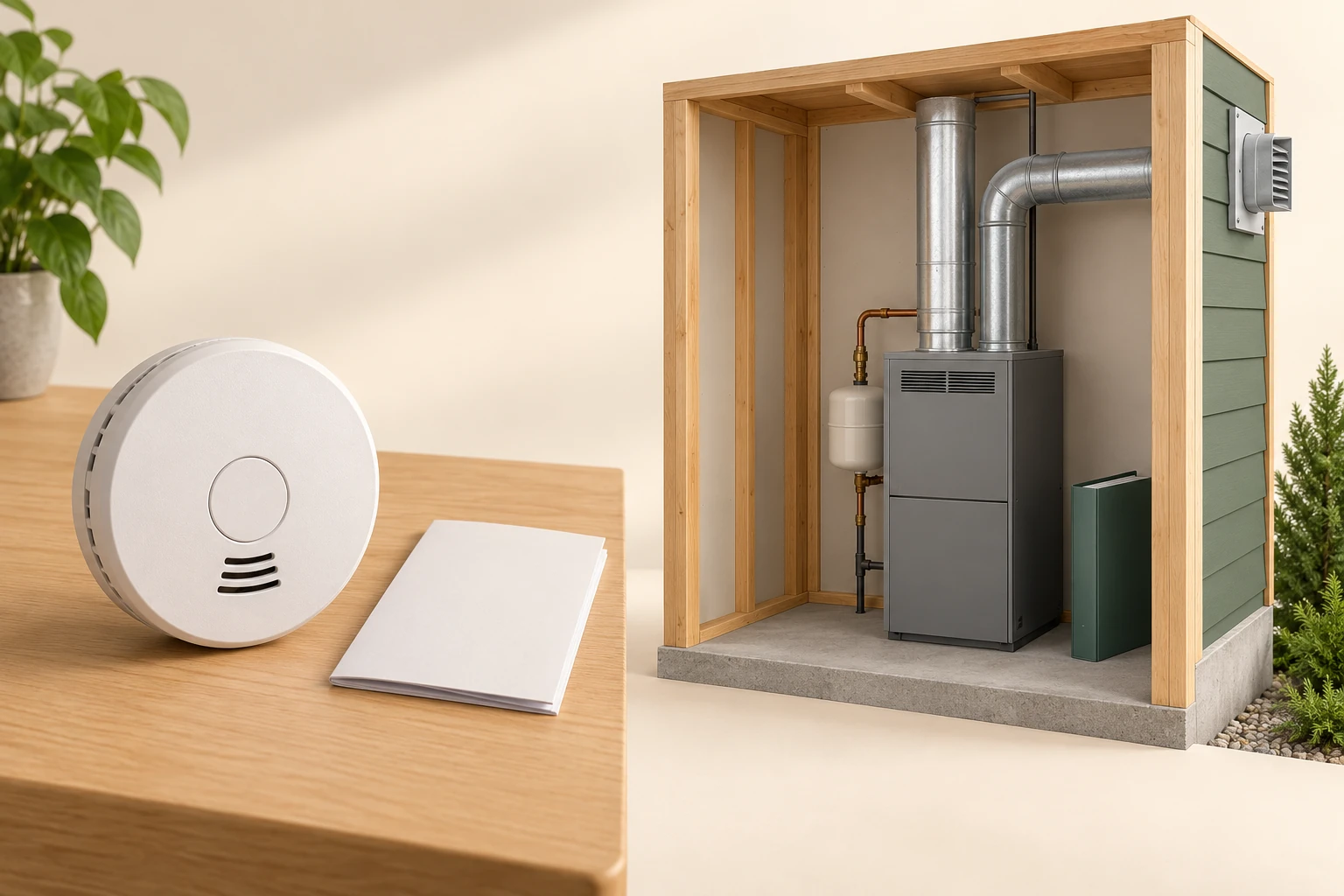
The alarm and its instructions have a warning-device job. The separate appliance and service folder introduce equipment care and investigation. Both matter in routine prevention.
About this illustration
No actual alarm identity, working sensor, required placement, replacement interval or equipment safety finding is established. The device is displayed separately, not mounted in a recommended location. This is a conceptual teaching model, not an assessment of your home.
4 picture lessons appear beside the questions in this guide. Use them to understand the explanation, then consider what it means for your home.
A carbon monoxide alarm is an evacuation signal
If a carbon monoxide (CO) alarm sounds or CO exposure is suspected, leave immediately and move to fresh air. Once outside, call 911 or emergency services. Do not search for the source, stay to check an appliance or wait for a chat answer.
CO is a poisonous gas that you cannot see, smell or taste. An alarm is there to warn you; your senses cannot confirm that the air is safe. A familiar appliance, recent service visit or quiet alarm afterward does not cancel the need for professional help.
Possible CO symptoms can require this response even without an alarm. Leave for fresh air and call from outside when exposure is suspected, and seek medical attention. Follow the responders’ re-entry directions; Health Canada says to return only after a professional has fixed the problem.
The explanations below are for understanding the home after immediate danger has been addressed, and for routine prevention. Keep that distinction clear: the first task during an alarm is getting out, not collecting a better record.
Leave first; call from outside
Two different hazard triggers lead to the immediate safety response. The gas-specific ignition caution stays visible beside its trigger.
Numbers identify the parts explained below.
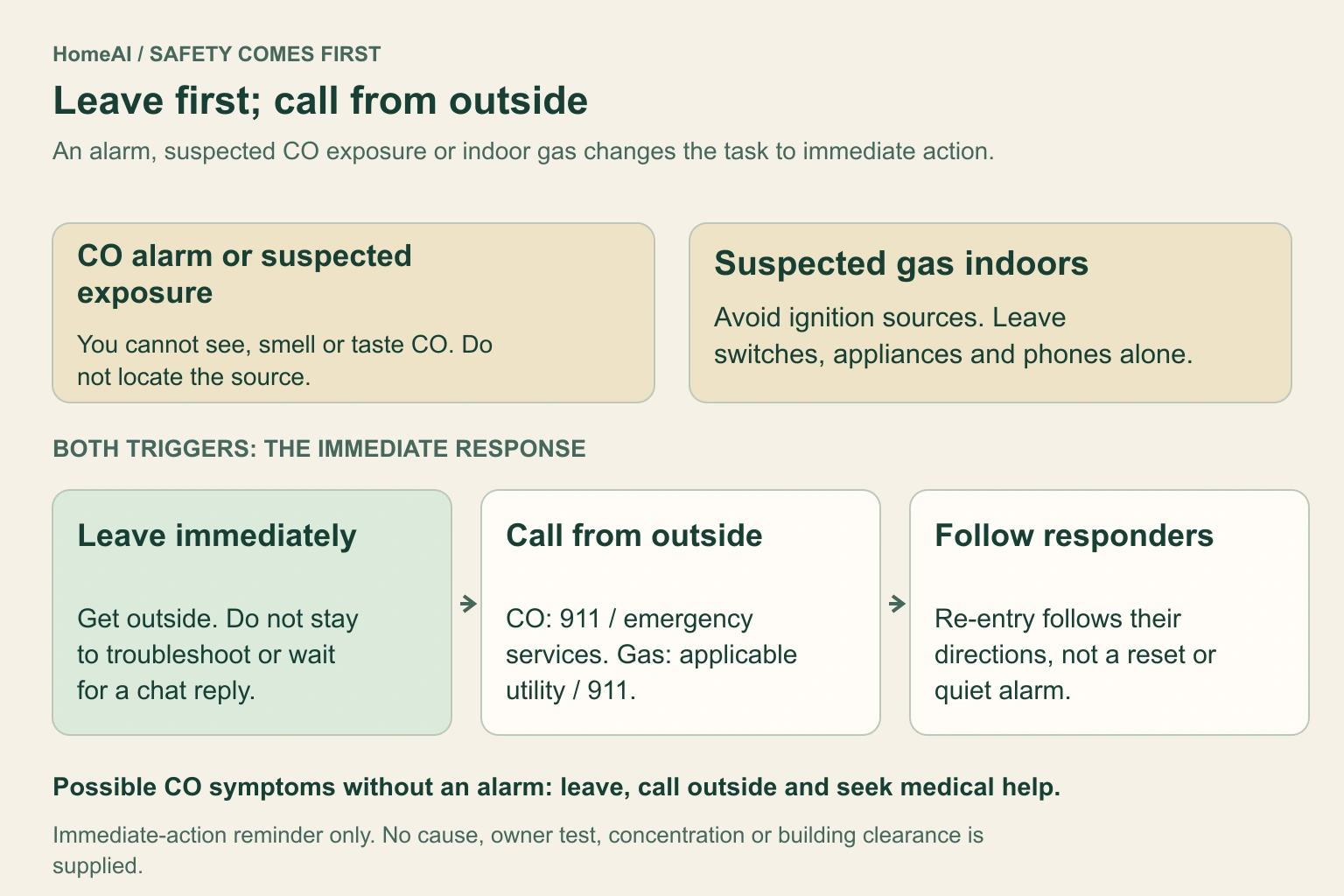
- Leave immediately
A CO alarm, suspected CO exposure or suspected gas indoors means getting out. Do not stay to find the source or troubleshoot.
- Call from outside
For CO, call 911 or emergency services. For suspected gas, call the applicable utility or 911 outside. Avoid switches, appliances, phones inside and ignition sources when gas is suspected.
- Follow responders
Re-entry follows the professionals’ directions. A quiet alarm, fan, open window or reset does not establish clearance.
What does this illustration leave out?
This diagram does not identify a cause or authorize re-entry. Follow the actual responding professionals. Immediate-action reminder, not a troubleshooting flowchart. Do not stay inside to collect information or wait for an assistant reply.
Once immediate safety is professionally addressed, what routine prevention information should I retain?
Explore this with HomeAI ↗Opens an editable question. Nothing is sent until you choose to send it.Leave first. Call from outside.
A CO alarm or suspected CO exposure and suspected gas indoors are different triggers. Both take priority over explanation or routine maintenance. The diagram connects each trigger to leaving immediately, calling outside and following the responding professionals.
- Leave immediately
- A CO alarm, suspected CO exposure or suspected gas indoors means getting out. Do not stay to find the source or troubleshoot.
- Call from outside
- For CO, call 911 or emergency services. For suspected gas, call the applicable utility or 911 outside. Avoid switches, appliances, phones inside and ignition sources when gas is suspected.
- Follow responders
- Re-entry follows the professionals’ directions. A quiet alarm, fan, open window or reset does not establish clearance.
Possible CO symptoms can require leaving for fresh air and calling from outside even without an alarm; seek medical attention when exposure is suspected. For suspected gas, avoid ignition sources and do not operate switches, appliances or a phone inside. CO cannot be identified by smell. A silent alarm cannot dismiss suspected gas, and a reset, open window or fan cannot authorize re-entry. This reminder provides no source-finding task, owner test or clearance result.
The immediate response comes before explanation
- CO alarm or suspected exposureLeave immediately for fresh air; call 911 or emergency services from outside. · Possible CO symptoms need action even without an alarm; do not locate the source or troubleshoot.
- Suspected gas indoorsLeave without operating switches, appliances or a phone inside; call the applicable utility or 911 outside. · Avoid ignition sources; a silent CO alarm does not dismiss the concern.
- Routine preventionUse actual alarm and appliance instructions, qualified service and relevant records. · This workflow applies after immediate danger is addressed.
Gas smell indoors changes the next step
If you suspect gas indoors, leave immediately. Do not operate lights, switches, appliances or a phone inside, and avoid flames or other ignition sources. From outside, call the applicable gas utility or 911. Keep others clear and follow the response team’s directions.
CO and a suspected fuel-gas leak are different concerns. FortisBC explains that it adds an odourant to its natural gas so a leak can smell like rotten eggs. CO itself has no smell. Do not use a silent CO alarm to dismiss suspected gas.
FortisBC’s contact details serve its British Columbia service area; use your own utility’s emergency contact where you live. This guide does not identify a smell remotely or ask you to distinguish a leak from another household odour before leaving.
Do not investigate gas fittings, relight equipment, open an appliance or try a flame-based leak check. A window, fan or apparent disappearance of the smell does not authorize re-entry. The qualified emergency response takes priority over a repair discussion.
Prevention is a maintenance task
A fuel-burning furnace, water heater or fireplace needs air for combustion: burning the fuel. Its products of combustion also need the intended route out of the home. Equipment designs differ. A direct-vent example can have separate outside-air and exhaust routes; other equipment uses a different arrangement.
Room ventilation has another job: replacing indoor air and removing or diluting indoor pollutants and moisture. A bathroom fan moves room air. It does not repair a faulty combustion appliance or establish that its exhaust is leaving correctly. Keep ventilation care and combustion service as connected, separate tasks.
Arrange professional equipment inspection and service using the actual manufacturer’s instructions and current authoritative guidance. Health Canada also identifies blocked outdoor exhaust paths as a prevention concern during snowstorms. Observe only from ordinary safe ground; inaccessible or uncertain routes belong to the appropriate service professional.
Keep fuel-burning generators and outdoor combustion equipment out of the home, garage and shed. Do not idle a vehicle in a garage even with its door open. Use the full current safety guidance for portable equipment; an alarm or automatic shutoff does not make indoor generator use acceptable.
Fuel-burning equipment needs air and an exhaust route
Two separate tubes connect the closed appliance to outside. They introduce the air-intake and combustion-exhaust jobs in one conceptual direct-vent example.
Numbers identify the parts explained below.
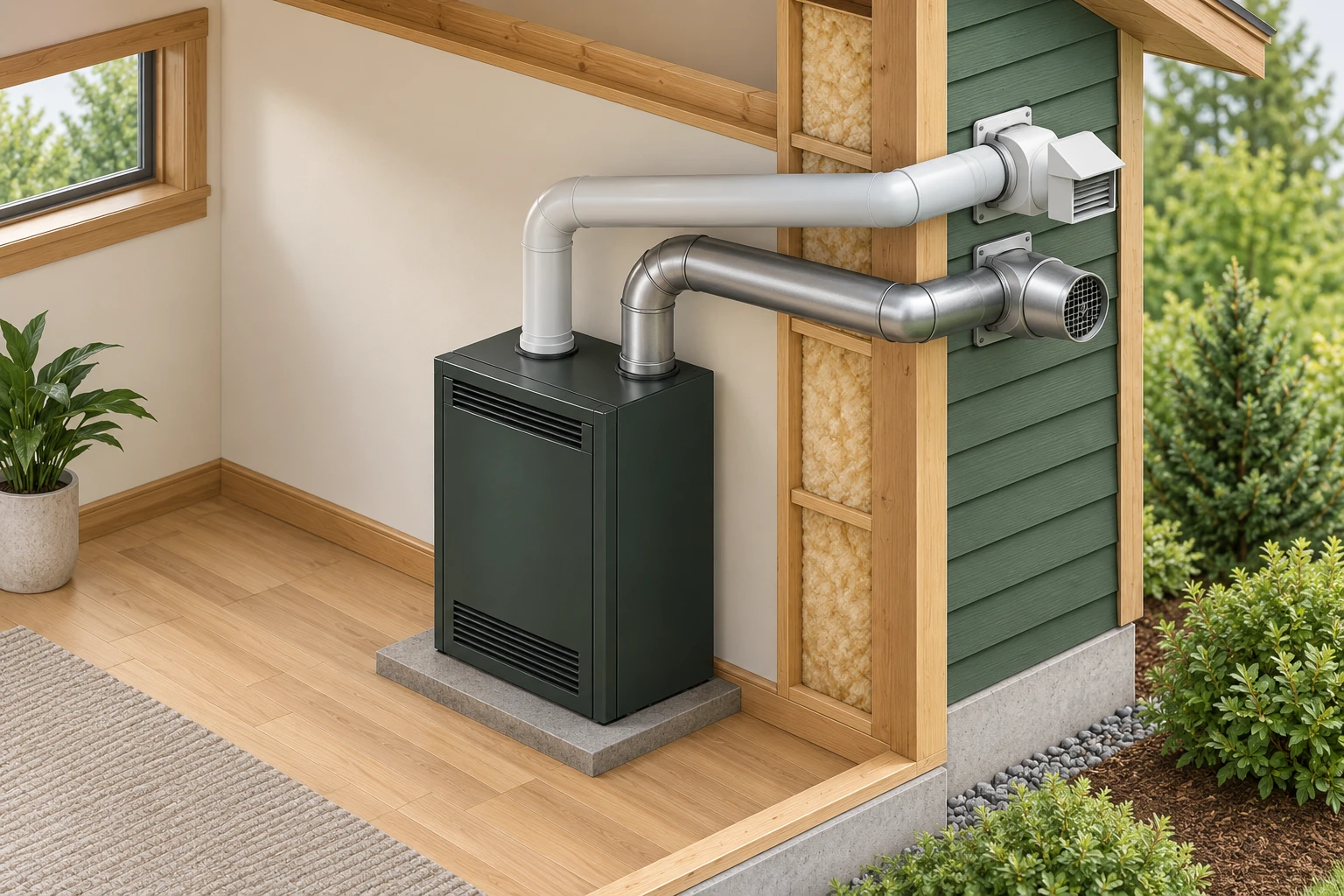
- Air intake
This example has an outside-air route for the appliance. Other equipment can use a different air-supply arrangement.
- Combustion exhaust
The other route represents products of combustion leaving the appliance. Its material and outside end are illustrative, not installation instructions.
- Closed appliance
A technician identifies the actual equipment and assesses its air supply and venting. A closed cover cannot establish internal condition.
What does this illustration leave out?
The picture supplies no actual model, approved terminal design, clearance, gas reading or venting assessment. The equipment instructions and qualified assessment determine the installed arrangement. A CO alarm, suspected CO exposure or suspected indoor gas needs the immediate response described at the start of the guide. Do not inspect or operate equipment to investigate a present concern.
Which air-supply and exhaust arrangement does this appliance use, and what did its service assessment cover?
Explore this with HomeAI ↗Opens an editable question. Nothing is sent until you choose to send it.What HomeAI can explain afterward
After responders have addressed the immediate condition, HomeAI can explain the jobs of the alarm, appliance, air supply and venting. That helps turn “something went wrong” into specific questions for the technician. The explanation is educational; the on-site findings determine the next work.
Ask which equipment and venting were examined, what methods were used, what was found and which corrective work was completed. A qualified professional may assess combustion, gas supply, exhaust and relevant pressure interactions within their assignment. Keep the actual report rather than filling missing details with a plausible story.
If ventilation, air sealing or a large exhaust appliance has changed, tell the responsible professional. Removing household air can affect pressure and some combustion arrangements. Ask whether that interaction needs assessment; do not run competing fans and fuel-burning equipment to create your own challenge test.
An event report and a service invoice answer different questions. The report describes the response and findings. The invoice describes its billed work. Neither should be stretched beyond its stated scope to promise that every appliance, vent or room has been assessed.
Build prevention around the actual equipment
Start with a simple equipment list: the installed fuel-burning appliances, their models, manuals and service contact. Add the alarms and their own instructions. This makes routine care easier to plan and helps the next technician identify the equipment without relying on a listing photo or house age.
The CO alarm warns about CO; the appliance and venting need appropriate service. Health Canada advises using alarms certified to Canadian safety standards and following the manufacturer for installation, use, maintenance and replacement. Read the actual label and instructions rather than applying another alarm’s expected life or signal pattern.
Ask your local fire department about current alarm guidance for the home. Provincial and local requirements, building arrangements and alarm models can differ. Calgary’s maintenance examples remain Calgary guidance. This page gives no universal number, mounting distance, replacement interval or required-location list for every Canadian home.
Keep unfamiliar openings and combustion-air provisions available for their intended job. Do not seal them to stop a draft or add an improvised vent screen. A professional can identify which openings serve combustion, exhaust or room ventilation and explain what the actual equipment requires.
An alarm warns; equipment service investigates
The alarm and its instructions have a warning-device job. The separate appliance and service folder introduce equipment care and investigation. Both matter in routine prevention.
Numbers identify the parts explained below.
- Alarm and instructions
Identify the actual alarm and follow its instructions. A CO warning calls for getting out, not checking its button here.
- Equipment and venting
The appliance and its actual air and exhaust arrangement need appropriate professional service.
- Service records
Keep the examined scope, findings and completed work. This blank folder contains no inspection result.
What does this illustration leave out?
No actual alarm identity, working sensor, required placement, replacement interval or equipment safety finding is established. The device is displayed separately, not mounted in a recommended location. Routine prevention belongs after immediate danger has been addressed. An alarm check does not clear the home.
Which alarm instructions and appliance service records apply to this home, and what follow-up remains?
Explore this with HomeAI ↗Opens an editable question. Nothing is sent until you choose to send it.Use records after the immediate risk is resolved
Keep the responding report, equipment service record, completed corrective work and agreed follow-up together. Record which appliance or route each document covers. If a cause report is unavailable, retain that gap beside the reported history instead of treating “resolved” as an explanation of what happened.
An owner can use the folder to plan the next service discussion. A buyer can ask what equipment is installed and which prior concerns were actually examined. A seller can provide the documents and their scope without converting one repair into a whole-home safety guarantee.
A realtor can help organize documents and introductions to specialists. If HAUSE home-system training is offered, verify the person’s actual training, licence, role and local availability. Their help with the transaction complements the qualified technical and emergency response; it does not replace them.
Missing paperwork calls for a useful question: what decision does it affect, and which targeted assessment could answer it? Ask the responsible specialist about that scope. Routine document collection never takes priority over a present alarm, suspected leak or immediate health concern.
Keep alarms, appliances and ventilation as separate evidence
An alarm manual explains that warning device. Appliance service records explain the equipment and work named in them. A ventilation report explains its air-moving system and measured conditions. Put the three together so their different jobs stay clear.
A manufacturer-directed alarm check concerns the stated device function. It does not establish that the home is free of CO or diagnose fuel-burning equipment. Follow the exact instructions during routine care; this guide adds no test sequence, induced exposure or method for checking an active incident.
An alarm event also does not locate its cause. A vent problem, appliance problem or pressure interaction remains a question until the actual investigation supports a finding. Keep the date, methods and limits beside that finding, particularly when later equipment or renovation changes the configuration.
Routine ventilation and an air cleaner cannot be used as treatment for faulty combustion or as a reason to stay inside during an alarm. Active CO or suspected gas goes back to the immediate response: leave, call from outside and follow the professionals’ directions.
Alarm care, appliance service and ventilation have different jobs
The cards name three different prevention roles and the records that help explain them.
Numbers identify the parts explained below.
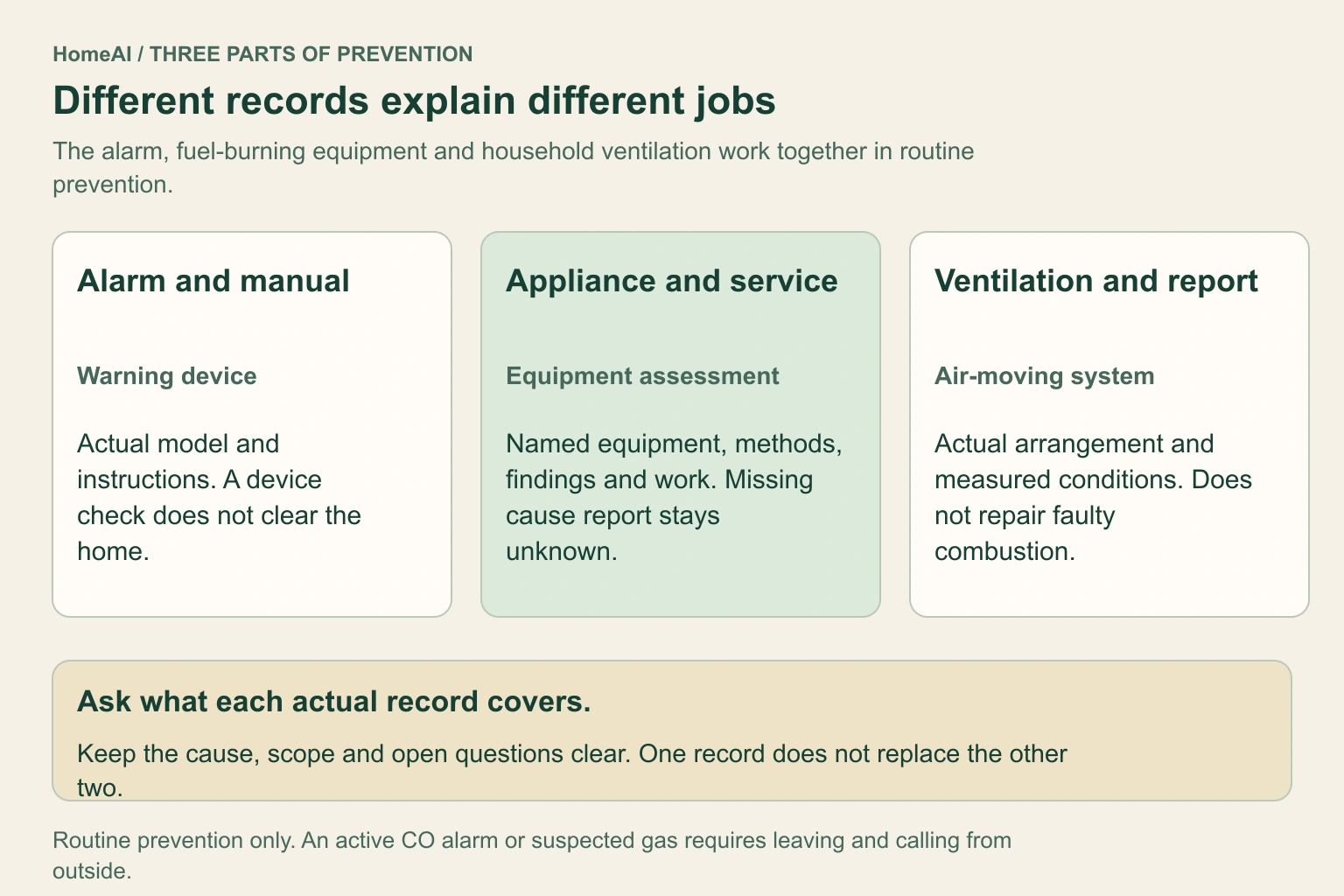
- Alarm and manual
Identify the warning device and its actual instructions. A manufacturer-directed device check does not clear the home.
- Appliance and service
Identify the fuel-burning equipment, examined scope, actual findings and work completed. Keep any missing cause report clear.
- Ventilation and report
Identify the air-moving arrangement and the measured conditions. Ordinary ventilation cannot correct faulty combustion or override an alarm.
What does this illustration leave out?
No completed device check, appliance assessment or home clearance is supplied. Ask what each actual record covers. Routine record comparison only, after immediate danger has been addressed. Alarm or gas incidents require leaving and calling from outside.
Which alarm, appliance and ventilation questions do my actual records answer?
Explore this with HomeAI ↗Opens an editable question. Nothing is sent until you choose to send it.Know which job each record explains.
The alarm warns; the appliance and venting need appropriate service; ventilation moves household air. Their records complement each other because they cover different equipment and questions.
- Alarm and manual
- Identify the warning device and its actual instructions. A manufacturer-directed device check does not clear the home.
- Appliance and service
- Identify the fuel-burning equipment, examined scope, actual findings and work completed. Keep any missing cause report clear.
- Ventilation and report
- Identify the air-moving arrangement and the measured conditions. Ordinary ventilation cannot correct faulty combustion or override an alarm.
Ask which actual model, methods and scope each record covers. A reported “resolved” incident without its original report leaves the cause unknown. A device check cannot clear the home, and ventilation cannot make faulty combustion acceptable. A present CO alarm or suspected indoor gas returns to the immediate response.
Three parts of prevention have different jobs
- Alarm and manualWarn about CO and explain the identified alarm’s care. · A device check does not clear the home.
- Appliance and service recordExplain the named equipment, venting assessment and work actually completed. · An invoice cannot supply an absent incident-cause finding.
- Ventilation and its reportExplain the air-moving arrangement and recorded operating conditions. · Ordinary ventilation does not correct faulty combustion or override an alarm.
Work through a fictional handover folder without a cause story
Nora is a fictional homeowner. Her handover folder contains an alarm manual, a furnace-service invoice and a note saying an older alarm incident was resolved professionally. The original responding report is missing. There is no current alarm or suspected leak in this routine learning example.
She can identify the alarm’s model and the equipment named on the invoice. She cannot infer that the furnace caused the older event or that the invoice explains it. She asks whether the original report can be recovered and leaves the cause marked unknown meanwhile.
For routine prevention, she follows the actual equipment guidance and asks the service professional which appliance and venting tasks apply. She keeps any later findings, work scope and follow-up in the folder. No invented measurement, repair outcome or clearance result is supplied here.
If a CO alarm sounds or gas is suspected, Nora leaves immediately and calls the appropriate emergency help from outside. She does not stay to read the folder, test a theory or reset equipment. The example explains how to organize prevention; it gives no permission to troubleshoot an active hazard.
Keep learning about the connected parts
Practice the distinction.
Nora separates the alarm manual from the missing cause report
Fictional routine handover example: the alarm manual and furnace invoice are available, but an older reported incident has no original responding report. No active hazard is part of this example.
Reported observations
- The actual alarm model can be identified.
- The invoice names its equipment and billed scope.
- A note reports professional resolution without identifying a cause.
Compare the explanations
Expand each possibility to see the evidence needed to distinguish it. Similar symptoms can have different mechanisms.
The original report may answer the incident question
Recovering a real responding or service report may establish a finding within its scope.
The actual report, its methods, findings and limits.
The cause remains unknown
The available note and invoice cannot be joined into an invented explanation.
The absent report is retained as an open question.
A useful next question
Use actual equipment instructions and qualified service advice for routine prevention. A present CO alarm or suspected gas immediately changes the task to leaving and calling from outside.
No real incident, measurement, cause finding, repair approval or clearance result is supplied.
Know what the words mean.
- Functional check
- A check described by the actual device manufacturer. Its stated result concerns that device, rather than the whole home.
- Reported resolution
- A statement that an earlier incident was addressed. Keep its supporting report and any unknown cause clear.
Questions to bring
to the conversation.
- Is there an active CO alarm, suspected gas or immediate health concern requiring the emergency response first?
- Which actual alarm and fuel-burning equipment models are documented?
- Which air-intake, combustion and exhaust arrangement did the professional identify?
- What does the responding or service report actually say, and which cause remains unknown?
- Which routine tasks, local guidance and follow-up apply to this equipment?
Separate a showing observation, an existing record and a new professional assessment. Unknown means a question remains; it does not automatically mean a defect.
Use the evidence planner ↗Go to the source.
Original HomeAI explanation informed by these public references. Sources support the underlying guidance; they have not reviewed or endorsed HomeAI. Diagrams are conceptual, and calculator outputs depend on your inputs.
References read for this refresh on October 5, 2026. Health Canada provides Canadian safety guidance; FortisBC emergency contacts serve its own British Columbia area and Calgary guidance is municipal. The named device and equipment instructions govern their particular models. Routine records never delay an alarm, suspected exposure or suspected indoor gas response.
Publication & source review
First published .
Sources reviewed .
Have a question about your home?
Start with the symptom, timing and what you have observed.
Ask HomeAI