- Overcurrent, GFCI and AFCI protection look for different electrical conditions.
- A trip describes an event; identifying its cause requires a suitable assessment.
- Use accessible TEST buttons only as the actual manufacturer directs.
- Recurring trips and signs of damage need qualified help; immediate danger comes first.
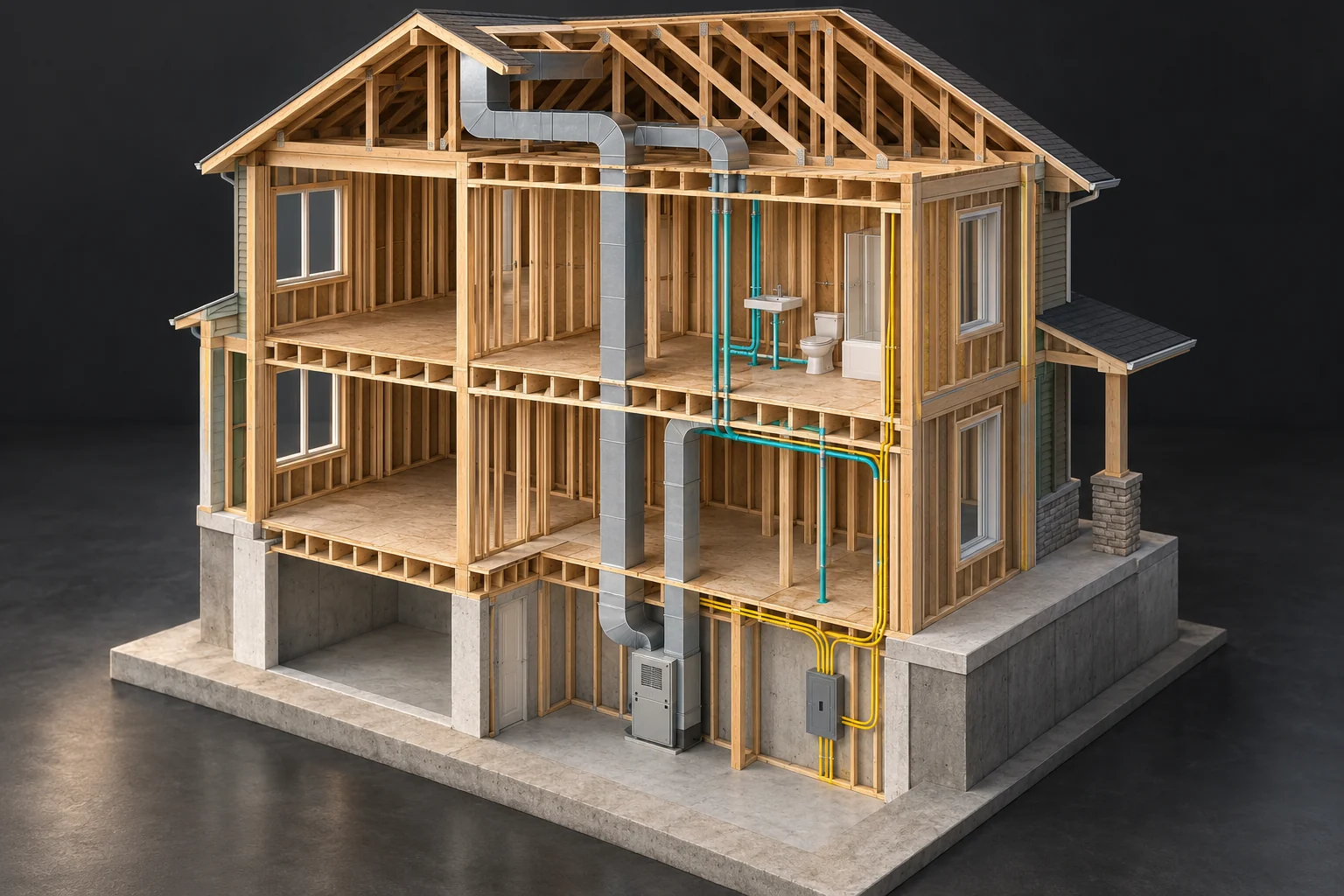
Conceptual architecture. Layout, sizes and routes are illustrative; the picture does not describe your home’s condition.
Explore this in the visual atlas ↗4 picture lessons appear beside the questions in this guide. Use them to understand the explanation, then consider what it means for your home.
A breaker responds to overcurrent
A circuit supplies electricity to the lights, outlets or equipment connected to it. The breaker can interrupt that supply. Its overcurrent function responds when current is excessive under the device’s designed conditions, helping protect the circuit wiring from overheating.
An overload can happen when the connected equipment draws too much current. A short circuit gives electricity an unintended shortcut that can produce a much larger current. Both raise overcurrent questions, but the fact that power stopped does not tell you which occurred.
The breaker’s contacts are the internal parts that make or break the electrical connection. Its trip mechanism opens them when the relevant protective condition is detected. The diagram explains those jobs; it shows no live conductors, time curve or installation to copy.
Keep the breaker label and manufacturer instructions with the home file. A device can combine overcurrent, GFCI or AFCI functions. The number on its front is not a household energy budget, and adding up breaker ratings does not establish the capacity available for an upgrade.
The breaker interrupts excessive current
The cards follow the jobs from connected equipment to overcurrent detection and supply interruption. Separate descriptions explain overload and short-circuit questions.
Numbers identify the parts explained below.
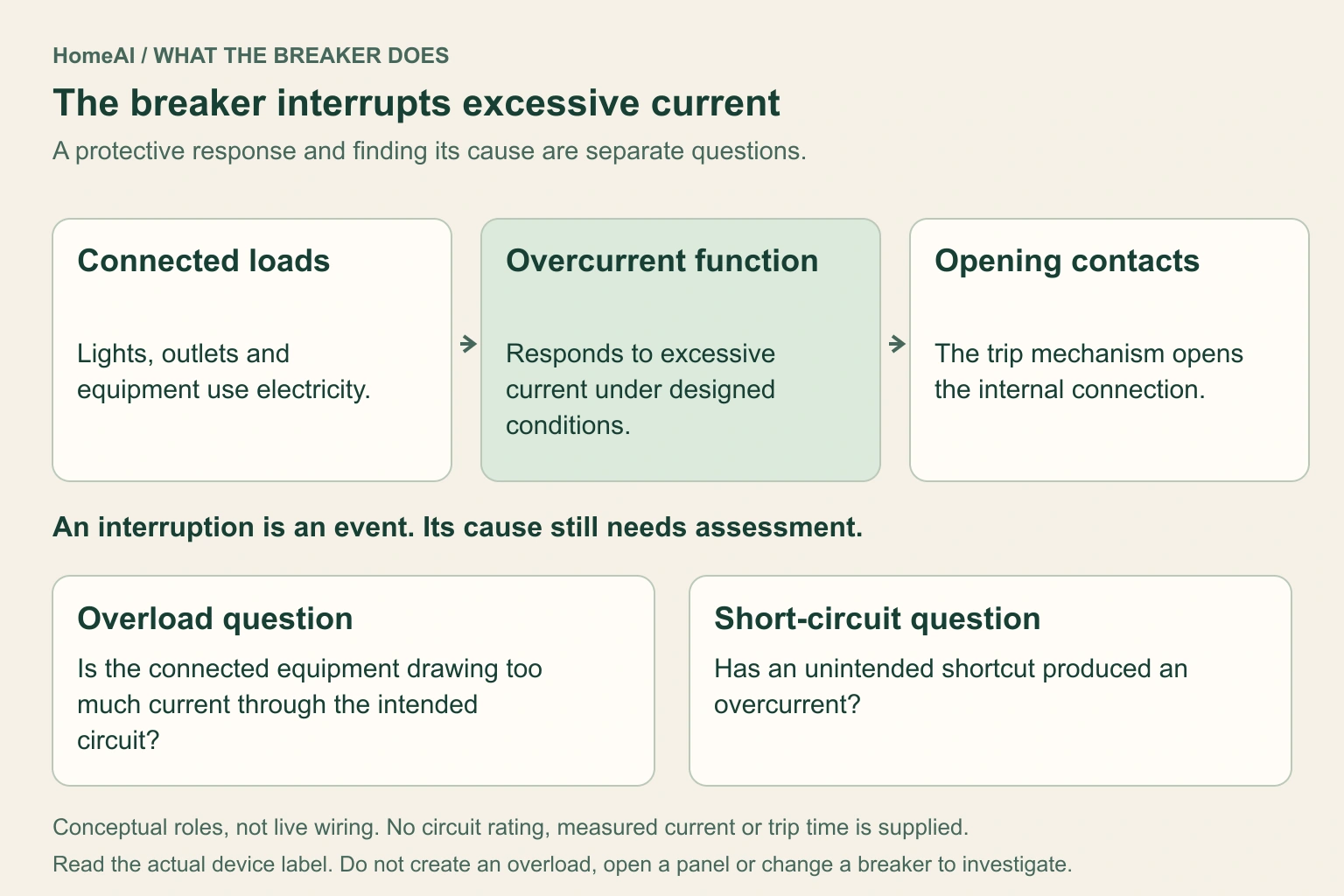
- Connected loads
Lights, outlets and equipment use electricity supplied by the circuit.
- Overcurrent function
The device responds to excessive current under its designed conditions.
- Opening contacts
The trip mechanism opens the internal connection and interrupts the supply. The interruption alone does not identify the cause.
What does this illustration leave out?
This diagram supplies no circuit rating, current measurement, trip time or diagnosis. Ask which function the actual device provides and what the professional found. Conceptual equipment functions, not a wiring design, overload experiment or installation specification. Read the actual label and instructions without opening covers.
Which protective function interrupted the supply, and which cause remains to be assessed?
Explore this with HomeAI ↗Opens an editable question. Nothing is sent until you choose to send it.Follow the job from equipment to interruption.
Connected loads use electricity. The overcurrent function responds to excessive current under designed conditions, and the trip mechanism opens internal contacts to interrupt the supply. The arrows connect these roles; they are not physical wires.
- Connected loads
- Lights, outlets and equipment use electricity supplied by the circuit.
- Overcurrent function
- The device responds to excessive current under its designed conditions.
- Opening contacts
- The trip mechanism opens the internal connection and interrupts the supply. The interruption alone does not identify the cause.
- Overload question
- Is the connected equipment drawing too much current through the intended circuit? The diagram supplies no load calculation.
- Short-circuit question
- Has an unintended shortcut produced an overcurrent? The diagram supplies no fault test or location.
Both explanations remain questions until a suitable assessment supports a finding. No circuit rating, current measurement or trip time is supplied. Do not create an overload, open a panel or change a breaker to investigate. Read the actual device label and ask the professional which function and cause were identified.
Three functions answer three different questions
- OvercurrentIs current excessive under the device’s designed conditions? · The function helps protect the circuit wiring from overheating.
- GFCIDoes monitored outgoing current differ from returning current? · The function addresses certain unintended current paths and shock risks.
- AFCIAre electrical characteristics associated with certain hazardous arcing detected? · The function addresses an arcing fire-risk question.
GFCI looks for an imbalance
A ground-fault circuit interrupter, or GFCI, compares current going out to the connected equipment with current returning through the monitored conductors. If some current takes another path, the amounts can differ. The device interrupts power when that difference meets its designed conditions.
This comparison asks a different question from “is the circuit overloaded?”. A current path through a person or another unintended route can be dangerous without an ordinary overcurrent breaker detecting enough current to operate. GFCI protection reduces certain shock risks; it cannot make touching electrical parts safe.
GFCI protection can be built into a breaker or an outlet. An outlet with TEST and RESET buttons may also protect other outlets connected through it. Which ones depend on the actual installation and device. An outlet in another room cannot be assigned protection from appearance or proximity.
Leviton’s named receptacle instructions distinguish GFCI operation from overload and short-circuit protection. Schneider’s named breaker FAQ explains the outgoing-and-returning comparison. These manufacturer examples teach the function; their ratings, connections and test procedures are not instructions for every Canadian installation.
GFCI compares current out with current back
The left panel shows matching monitored amounts. The right panel shows another route and a possible difference between the monitored amounts.
Numbers identify the parts explained below.
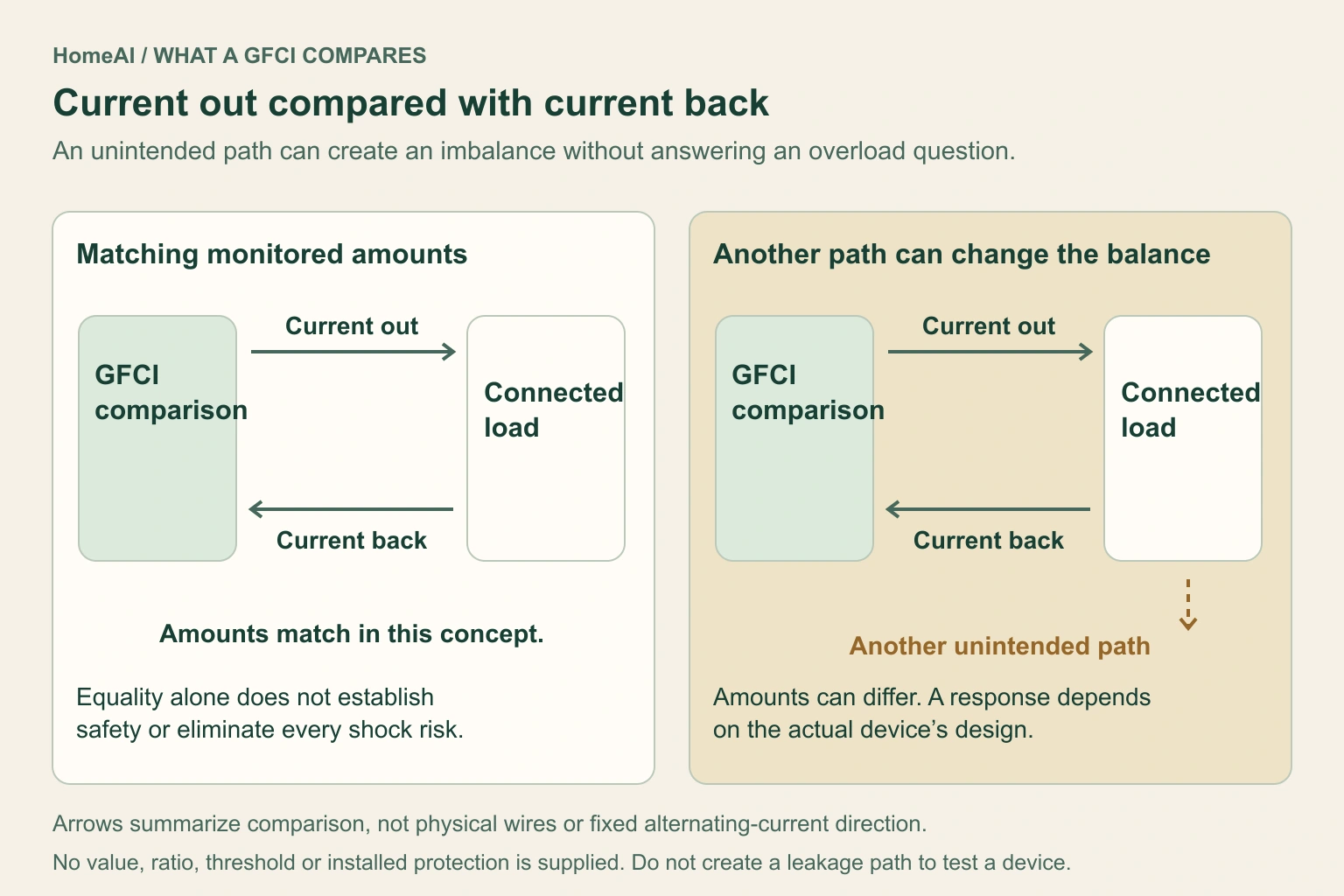
- Outgoing current
The device monitors current going to the connected load through the monitored conductors.
- Returning current
It compares the current returning through those monitored conductors with the outgoing amount.
- Another path
If some current takes another route, the monitored amounts can differ. A GFCI interrupts when the imbalance meets its designed conditions. No value or threshold is supplied.
What does this illustration leave out?
No actual leakage, installed protection, current value or threshold is supplied. Equal monitored amounts do not establish that every shock risk or wiring hazard is absent. Conceptual current comparison only. Arrows are not physical conductors or a measured waveform. Do not create a leakage path or touch wiring to test a device.
What does the identified GFCI monitor, and which outlets does the actual installation protect?
Explore this with HomeAI ↗Opens an editable question. Nothing is sent until you choose to send it.Compare the monitored current out and back.
The two panels explain what a GFCI compares. Arrows summarize current relationships rather than physical conductors or fixed alternating-current direction. No measured amount, ratio or threshold is supplied.
- Outgoing current
- The device monitors current going to the connected load through the monitored conductors.
- Returning current
- It compares the current returning through those monitored conductors with the outgoing amount.
- Another path
- If some current takes another route, the monitored amounts can differ. A GFCI interrupts when the imbalance meets its designed conditions. No value or threshold is supplied.
- Matching monitored amounts
- The conceptual left panel has equal outgoing and returning amounts. Equality alone does not establish safe wiring or eliminate every shock risk.
- Another path and an imbalance
- The right panel adds an unintended route. A difference between the monitored amounts can produce a protective response when it meets the actual device’s designed conditions.
A GFCI receptacle does not replace overload or short-circuit protection. A named breaker may combine functions. Actual downstream protection depends on the installation and model, rather than an outlet’s appearance or room. Do not create a leakage path, touch wiring or use this picture as a test procedure.
AFCI addresses arc-fault conditions
An electrical arc is electricity crossing a gap. Unwanted arcing at a damaged cord, wire or connection can create heat. An arc-fault circuit interrupter, or AFCI, looks for electrical characteristics associated with certain hazardous arcing conditions and interrupts power when its design calls for it.
AFCI protection asks about those arcing characteristics. GFCI protection asks about current imbalance. The functions can be combined in a named dual-function device, but a familiar TEST button alone does not tell you which functions are present. Read the actual label and manual.
A trip associated with switching on an appliance is useful timing information. It is not proof that the appliance, hidden wiring or protective device caused the event. The professional needs to identify the device and investigate the circuit and equipment within an agreed scope.
Do not defeat protection, change the device type to stop trips, install a larger breaker or keep resetting a device that will not hold. Leave panel access and wiring work to the appropriate electrical professional. The conceptual diagram contains no measured waveform or method for creating an arc.
AFCI detection is different from finding the cause
The top row explains the protective response. The lower row shows the information and assessment needed to investigate a reported interruption.
Numbers identify the parts explained below.
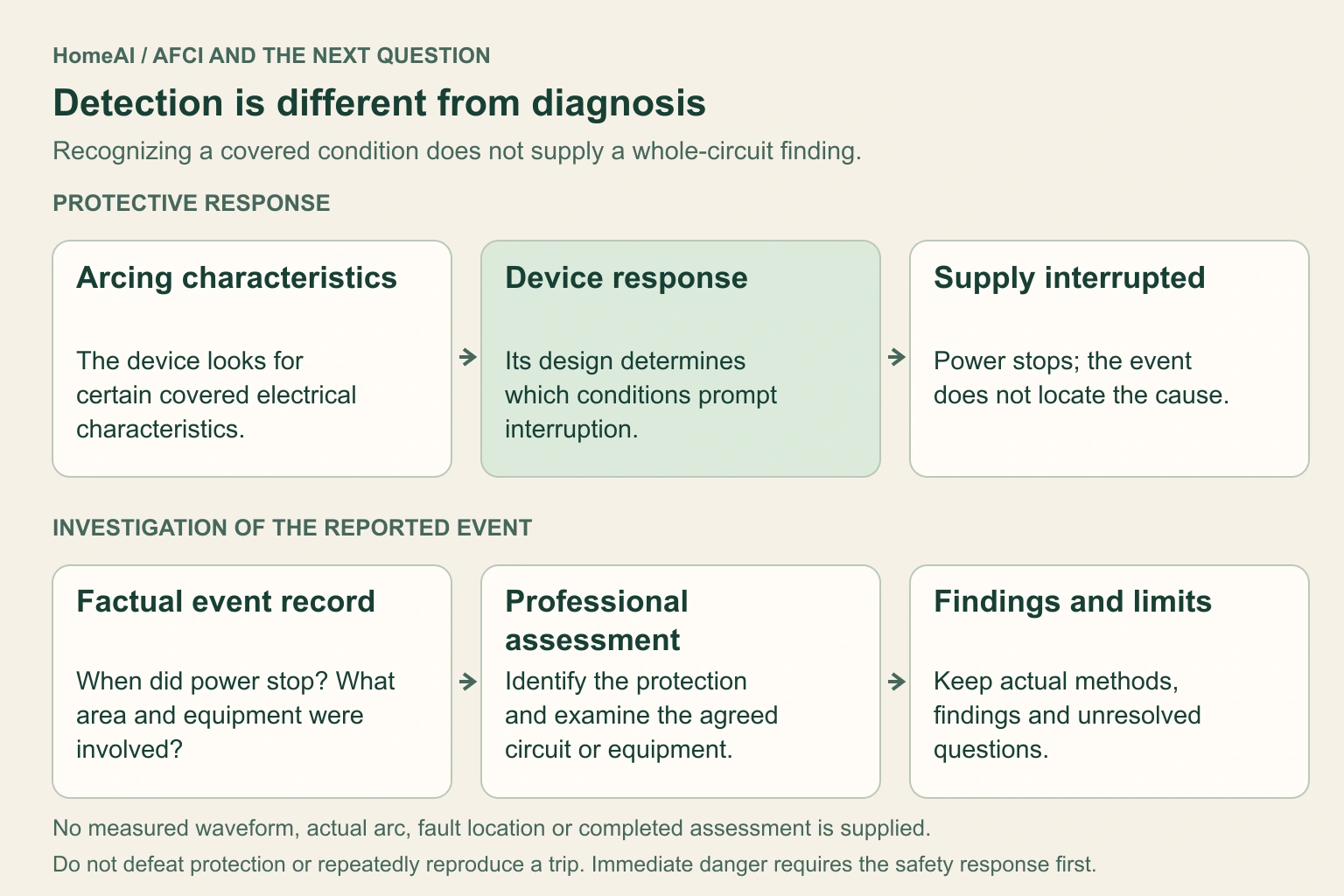
- Detect arcing characteristics
AFCI protection looks for electrical characteristics associated with certain hazardous arcing conditions; the exact device design governs its response.
- Record the interruption
Report when power stopped, which area was affected and what equipment was in use. The event does not locate an arc or establish a cause.
- Request the assessment
The qualified professional identifies the device and investigates the stated circuit or equipment scope. Keep the actual methods, findings and unresolved questions.
What does this illustration leave out?
The relationship explains roles. It proves no actual arc, trip code, fault location, safe circuit or completed investigation. Conceptual detection and assessment roles, without a waveform, numerical threshold or method for creating an arc. Do not defeat protection or repeatedly reproduce a trip.
What happened, which protection is identified, and what did the actual assessment establish?
Explore this with HomeAI ↗Opens an editable question. Nothing is sent until you choose to send it.Keep detection, the reported event and the finding separate.
The top row explains a covered protective response: the device recognizes certain arcing characteristics and interrupts the supply. The lower row explains how a reported interruption becomes a useful request for professional investigation.
- Detect arcing characteristics
- AFCI protection looks for electrical characteristics associated with certain hazardous arcing conditions; the exact device design governs its response.
- Record the interruption
- Report when power stopped, which area was affected and what equipment was in use. The event does not locate an arc or establish a cause.
- Request the assessment
- The qualified professional identifies the device and investigates the stated circuit or equipment scope. Keep the actual methods, findings and unresolved questions.
- Protective response
- Certain arcing characteristics → the device’s designed response → supply interrupted. No actual signal, measured waveform or fault location is supplied.
- Investigation
- Factual event record → assessment of identified equipment or circuit → actual findings and limits. The diagram supplies no completed assessment.
An appliance was in use when power stopped: that timing does not prove the appliance caused an arc. Indicators require the exact model’s instructions. Do not defeat protection, reproduce trips or invent an arcing experiment. Recurring interruptions require qualified help; immediate smoke, sparks, fire or wet electrical hazards require the safety response first.
What to observe without doing electrical work
From a safe, dry position, record what stopped working, when it happened and which ordinary appliances were in use. Keep any safely readable device label, model or existing panel directory. A directory can help explain the affected area, while an old or incomplete label still needs verification.
Use accessible TEST buttons only as directed by the actual manufacturer, with the relevant precautions and expected result. The manual should govern the check and its schedule. Do not open a cover, pull out an outlet or add an improvised fault to test protection.
The TEST button checks a stated device function. It does not inspect every hidden connection, establish all downstream protection or clear the circuit for new loads. If the check does not behave as instructed, stop using it as reassurance and arrange the manufacturer-directed professional response.
Stay clear of damaged equipment and water near electrical parts. Heat, buzzing, burning smells or recurring trips need prompt qualified help. Smoke, sparks, an active fire or immediate danger require leaving and calling emergency services from outside; do not stay to gather photographs.
Start with the accessible exterior
The closed panel and outlet faces show familiar places to find equipment information. They are separate examples; the picture does not identify a connected or protected circuit.
Numbers identify the parts explained below.
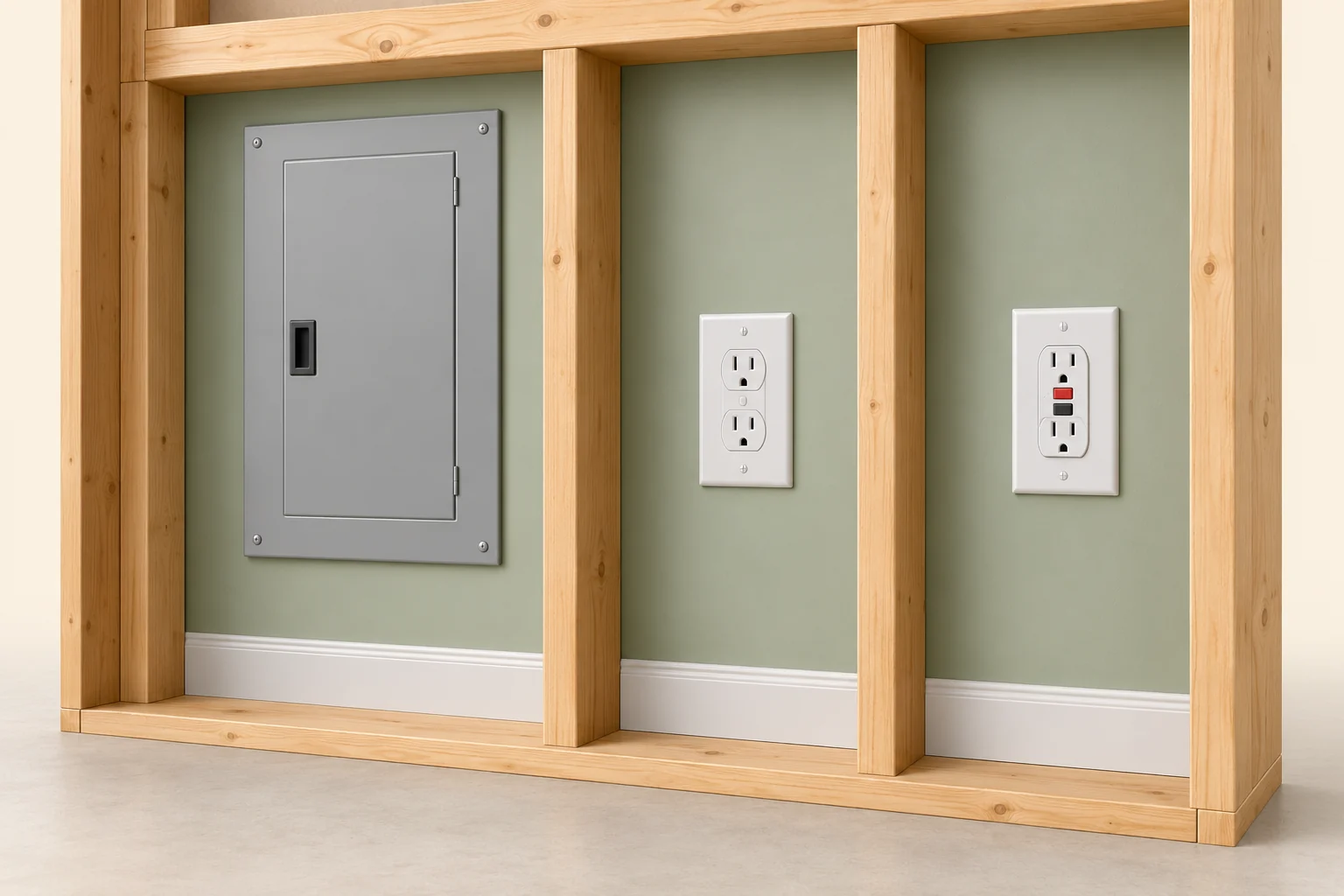
- Closed panel
Read safely accessible exterior information. Keep the panel closed; internal examination belongs to the electrical professional.
- Plain outlet face
An outlet’s appearance cannot tell you whether another device protects it. Ask the electrician which outlets belong to the assessed circuit.
- Buttons on the face
Match the actual device to its instructions. Buttons and their colour alone do not establish every protective function or a successful test.
What does this illustration leave out?
These generic faces show no readable model, certification, measured function, connections or downstream coverage. Follow the actual manufacturer instructions for permitted owner checks. A photograph or successful reset is not a complete safety assessment. Never remove a panel cover or outlet plate, touch wiring, bypass protection or reproduce a fault for this lesson. Stay clear of wet or damaged electrical equipment.
What is the actual device model, what protection does it provide, and which circuit or outlets did the professional assess?
Explore this with HomeAI ↗Opens an editable question. Nothing is sent until you choose to send it.Read protection without diagnosing the circuit
A trip is an interruption event. A diagnosis explains the cause using suitable observations or tests. Keep those two facts separate: “power stopped while the appliance was running” is a useful report, while “the appliance caused the fault” needs supporting assessment.
Possible explanations can involve the connected equipment, a cord, a connection, the branch wiring, the device or their interaction. A professional chooses methods after identifying the protection and circuit. Do not repeatedly recreate the event, move suspect equipment around or bypass a device to compare outcomes.
Some models provide indicator lights or diagnostic records. Their meaning comes from the exact manual and edition. A light’s colour or a handle position cannot be treated as a universal code across brands, and a device indication does not reveal every inaccessible part of the circuit.
Ask the report to identify what was examined, the method used, the findings and anything left unresolved. An appliance-only assessment cannot establish the condition of all household wiring. A successful reset is a moment of operation, not evidence that every electrical hazard is absent.
Plan upgrades as a connected project
An EV charger, heat pump, electric cooker or workshop may add different electrical demands. Bring the intended equipment and how you expect to use it to the professional. The useful question is how the proposed loads fit the existing supply, circuits and protection.
Empty panel spaces show physical room for devices. They do not establish spare electrical capacity. A modern-looking enclosure also does not establish conductor condition or suitable protection. Ask for a property-specific load assessment and the options it supports before assuming a service replacement is necessary.
Keep the proposal, equipment information, permitted work scope and relevant completion records together. For a sale, describe the work actually documented. A partial invoice may explain one replaced circuit or device; it cannot support “all wiring updated” without a wider verified scope.
A realtor can help organize documents and specialist introductions. If HAUSE home-system training is offered, verify the person’s actual training, licence, role and local availability. A showing and an agent’s familiarity with houses do not replace an electrical assessment by the responsible qualified professional.
Separate a protective response from an electrical diagnosis
Start by naming the function: overcurrent protection responds to excessive current, GFCI to monitored current imbalance, and AFCI to certain arcing characteristics. One device may provide more than one function. The label and applicable instructions explain what that particular equipment is designed to do.
Keep three records together: the reported event, the manufacturer-directed device check and any professional finding. They answer different questions. The event describes what happened; the check concerns a device function; the assessment investigates the stated equipment or circuit scope.
Canadian location, work-authorization and inspection arrangements vary. Calgary’s maintenance examples are municipal guidance. ESA’s contractor and notification language applies in Ontario. Manufacturer pages hosted for Canada may also discuss U.S. NEC rules; those passages do not establish a Canadian home’s requirements.
Ask the relevant local authority and electrical professional which current requirements apply to the actual work. This guide provides no universal testing interval, required-location list or retrofit approval. Keep the model, source edition, jurisdiction and date visible when comparing an instruction with an older home record.
An event, device check and diagnosis each have a job
- Reported eventWhen did power stop, and what was in use? · Timing alone does not identify the cause.
- Manufacturer-directed checkDid the stated device function behave as its instructions describe? · The result does not assess all hidden wiring or approve new loads.
- Professional assessmentWhich equipment or circuit was examined, by what method, with which finding? · Keep the scope, unresolved questions and subsequent work records.
Work through a fictional appliance-and-trip record
Maya is a fictional homeowner. Power has stopped repeatedly while one appliance was in use. She does not yet know whether the device has ordinary overcurrent, GFCI, AFCI or combined protection. No professional cause finding is available, and a normal-looking cord does not settle the question.
She stops repeated resetting and requests a qualified electrical assessment. Her notes describe the timing, affected area and available equipment information without naming a cause. She asks the contractor to identify the protection and explain which circuit and equipment questions their assignment covers.
If the report examines only the appliance, Maya keeps that limit beside the finding. If circuit work is later completed, she retains its actual scope and relevant local records. The useful outcome is an explained finding or an explicit outstanding question, rather than a whole-house safety claim.
If smoke, sparks, fire or immediate danger occurs, Maya leaves and calls emergency services from outside. For water near electrical equipment, she stays clear and contacts the utility or appropriate emergency help. The example supplies no inspected property, fault result, repair approval or permission to work on wiring.
Keep learning about the connected parts
- Buying a home with a pool or hot tub: understand the system and handover
- Electric heated floors: understand the heater, sensor and response
- Window and portable air conditioners: follow the heat out of the room
- Portable space heaters: follow the heat, controls and supply
- Power bars, surge protection and UPS: understand the different jobs
- Smart-home automations: follow the sensor, rule and physical result
Practice the distinction.
Maya asks why power stopped
Fictional learning scenario: power stops repeatedly during appliance use, and the type of protection and cause remain unknown.
Reported observations
- Maya records when power stopped and which area was affected.
- The appliance was in use, but its role in the event has not been established.
- No qualified cause finding is available.
Compare the explanations
Expand each possibility to see the evidence needed to distinguish it. Similar symptoms can have different mechanisms.
The circuit or equipment needs investigation
Timing does not distinguish the appliance, cord, branch circuit, protective device or their interaction.
A qualified assessment that first identifies the protection, then states the methods and findings.
A limited assessment leaves wider questions open
An appliance-only finding cannot establish the condition of all household wiring.
A report naming the equipment or circuit covered, exclusions and unresolved questions.
A useful next question
Stop repeated resetting, keep the factual event record and request the appropriately scoped professional assessment. Immediate smoke, fire, sparks or wet electrical hazards require the safety response first.
No real property, fault result, repair approval or owner wiring experiment is supplied.
Know what the words mean.
- Protective function
- The electrical condition a device is designed to detect and respond to. One device can have several functions.
- Scope boundary
- Which equipment, circuit and questions an assessment actually covered, including what was left unexamined.
Questions to bring
to the conversation.
- What actual device and protective functions are identified?
- When did the interruption happen, which area was affected, and what was in use?
- What does the exact manufacturer instruct for its accessible device check?
- Which circuit or equipment did the professional examine, and what remains unresolved?
- Which local work and completion records describe any repair or upgrade?
- Are heat, smoke, sparks, burning smells or wet electrical hazards changing the immediate response?
Separate a showing observation, an existing record and a new professional assessment. Unknown means a question remains; it does not automatically mean a defect.
Use the evidence planner ↗Go to the source.
Original HomeAI explanation informed by these public references. Sources support the underlying guidance; they have not reviewed or endorsed HomeAI. Diagrams are conceptual, and calculator outputs depend on your inputs.
Chapter references reviewed for this refresh on October 5, 2026. Canadian manufacturer pages describe named equipment or general mechanisms. Leviton instructions apply to the named receptacle family. ESA guidance is Ontario-specific. The retained CPSC page links a U.S. 2010 factsheet; U.S. placement rules and wiring procedures are not Canadian instructions. Match the actual model and relevant local work requirements.
Publication & source review
First published .
Sources reviewed .
- US Consumer Product Safety Commission · GFCI fact sheet
- City of Calgary · Home maintenance
- Electrical Safety Authority · Protection and damaged equipment
- Electrical Safety Authority · Flood safety
- Eaton Canada · Circuit breaker fundamentals
Where this reference applies
Jurisdiction: Canadian manufacturer website; general equipment mechanisms
Overcurrent, overload, short-circuit and interruption roles. The page also contains NEC definitions and industrial examples, which supply no Canadian residential design or adoption rule here.
- Schneider Electric Canada · How named GFCI breakers work
Where this reference applies
Jurisdiction: Canadian manufacturer FAQ; named North American breaker families
Outgoing and returning current comparison in the named QO/QOB/HOM/CHOM equipment. No numerical threshold, wiring connection or owner test is imported.
- Leviton · Named GFCI receptacle family instructions
Where this reference applies
Jurisdiction: Manufacturer instructions with Canadian support; specified receptacle family
Two-page PK-93792-10-00-0J, copyright 2025: protective-function limits, actual downstream arrangement, named self-test and manufacturer instructions. Installation, owner wiring and replacement procedures are not reproduced.
- Schneider Electric Canada · QO protection functions and diagnostics FAQ
Where this reference applies
Jurisdiction: Canadian manufacturer FAQ; QO equipment with U.S. NEC examples
AFCI, GFCI and dual-function roles, model-specific diagnostic information and possible equipment/circuit interactions. U.S. NEC adoption, HF thresholds, location rules and replacement or compatibility advice are not imported.
Have a question about your home?
Start with the symptom, timing and what you have observed.
Ask HomeAI