Jump to a question in this guide
- What does a room air conditioner actually do?
- How do room air, refrigerant and outdoor air stay different?
- What is different about a window unit?
- Why does a single-duct portable unit need room replacement air?
- What changes with a dual-duct portable unit?
- Where does the condensed water go?
- Does fan, dry or automatic mode mean the same as cooling?
- How should I compare capacity and efficiency labels?
- What can I observe when a room stays warm?
- Who should assess installation, supply and equipment?
- How do a fan, a dehumidifier and an air conditioner change the room differently?
- How can two cooling comparisons accidentally answer different questions?
- What seasonal and Canadian limits should remain visible?
- How would a fictional household explain a warm room and a water warning?
- A fan moves air; active refrigeration removes heat.
- Single and dual ducts concern the condenser-air route, distinct from room cooling.
- Condensate management depends on the actual model and mode.
- Capacity, efficiency and room suitability are different questions.
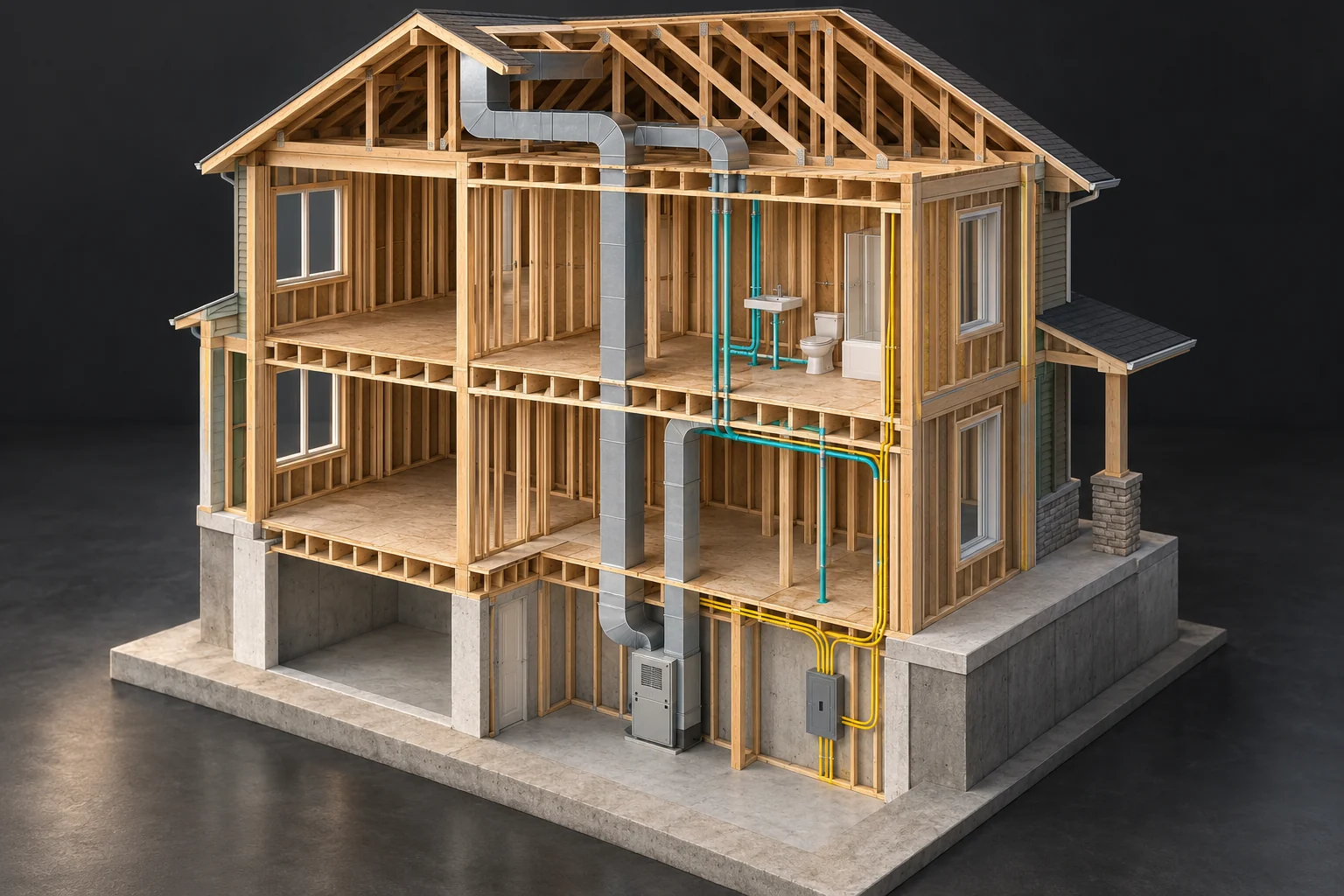
Conceptual architecture. Layout, sizes and routes are illustrative; the picture does not describe your home’s condition.
Explore this in the visual atlas ↗7 picture lessons appear beside the questions in this guide. Use them to understand the explanation, then consider what it means for your home.
What does a room air conditioner actually do?
A room air conditioner moves heat from the room to somewhere outside the cooled space. A fan passes room air over a cold heat exchanger, returning cooler air to the room. A refrigerant circuit carries the absorbed heat toward a hot heat exchanger, where another air route carries it away. Electricity runs the equipment; the useful cooling comes from removing heat, not merely from blowing air.
The familiar parts are the room-air inlet, filter, cool-air outlet, closed refrigeration equipment and heat-rejection route. Moisture can also condense on the cold exchanger and needs its own management. Follow air, heat and water separately. A unit with a fan running may have airflow without active cooling, and a visible exhaust hose does not explain where collected water goes.
Window units and portable units arrange those jobs differently. A window unit places its room and outdoor sides across the window or wall plane. A portable unit keeps the package inside and uses its specified duct arrangement to carry heat-rejection air outdoors. Both still need the rejected heat to leave the cooled space.
The opening pictures show closed equipment and distinct room/outdoor locations. They do not expose speculative compressor or coil geometry. The exact native figure supplies the causal heat journey so that the relationship stays readable even if the equipment casing hides it. Nothing in the picture establishes an approved support, electrical supply or refrigerant condition.
This guide focuses on room cooling, exhaust arrangements and condensate. The established heat-pump guide explains the wider reversible cycle, and the overheating guide addresses room heat gains and passive measures. Use those links when the question concerns the whole home. A portable appliance should not be assumed to answer every room’s cooling need.
Follow room heat, refrigerant and the outdoor rejection route
Choose any stage or play the lesson. A complete pass from stage 1 lasts 64 seconds, with eight seconds per reading stage during playback. Paused and manually selected stages remain available as long as you need. These highlights are not physical cycle times, control settings, measured performance or a test result.
A conceptual room-air-conditioner refrigeration circuit, with a separately labelled single-duct portable-air example. NRCan’s legacy room-AC body supports the mechanism, not current efficiency thresholds, refrigerant identity or operating advice.
- Indoor fan and evaporator: Move room air over the coil where heat is absorbed.
- Closed refrigerant circuit: Carries heat through the evaporator, compressor, condenser and expansion device; it is not an air duct.
- Condenser air route: Carries rejected heat outdoors; portable duct arrangements differ.
- Condensate: Water removed from room air follows the actual model’s management route.
Paused at stage 1 of 8.
Keyboard: use Tab to reach a control and Enter or Space to activate it. On a stage button, Left/Right selects the previous/next stage; Home/End selects the first/last stage.
Keep room air and refrigerant separate
An air conditioner moves heat out of the room. Room air passes over a coil, while refrigerant stays in a separate circuit inside the equipment. Neither route is a drinking-water supply.
Useful question: Which equipment type and exact model serve this room?
All eight reading stages
Keep room air and refrigerant separate
An air conditioner moves heat out of the room. Room air passes over a coil, while refrigerant stays in a separate circuit inside the equipment. Neither route is a drinking-water supply.
Useful question: Which equipment type and exact model serve this room?
The indoor fan moves air over the evaporator
The evaporator is the indoor heat-absorbing coil. As room air crosses it, heat passes into the refrigerant. Cooler air returns to the room; the same room-air stream is not drawn as travelling through the refrigerant pipe.
Useful question: What identifies the room-air intake and return in the actual equipment?
The compressor adds work to the circuit
Refrigerant leaving the evaporator reaches the compressor. Compression raises its pressure and temperature so heat can be rejected at the condenser. The lesson gives no pressure values, refrigerant specification or service procedure.
Useful question: What model and qualified service information identify the sealed circuit?
The condenser releases heat to another air stream
At the condenser, refrigerant gives heat to air that carries it outside the conditioned space. Removing room heat therefore needs a complete heat-rejection route, not just a fan blowing cool air toward an occupant.
Useful question: Where does the actual condenser heat go?
Window and portable units use different air routes
A window unit places its heat-rejection side outdoors. In the separately illustrated single-duct portable example, condenser inlet air comes from the room and leaves through an outdoor exhaust duct. A dual-duct model brings some or all condenser inlet air from outside through another duct.
Useful question: Which documented duct configuration belongs to this model?
The expansion device completes the refrigerant loop
After releasing heat, refrigerant passes through the expansion device toward the lower-pressure evaporator side. The circuit repeats while cooling operates. The eight reading stages are not eight timed machine steps or instructions to open that circuit.
Useful question: Is the sealed-system assessment being handled by the appropriate service provider?
Moisture has a separate water route
Moisture from room air can condense on the cold evaporator surface. That water is distinct from refrigerant and from condenser exhaust air. Its collection, evaporation or drainage arrangement depends on the actual model; this diagram stops at a labelled model-specific boundary.
Useful question: What does the exact manual say about condensate and any warning?
Record performance without assuming a diagnosis
Record the model, duct arrangement, room conditions, reported symptom and relevant service findings. A running fan does not establish heat rejection, moisture management or correct capacity. Follow model-specific care and qualified service rather than opening the circuit or inventing a drain procedure.
Useful question: Which observed result and unresolved route should the provider assess?
Use the source notes in this guide to check the named examples, adopted scope and limits.
How do room air, refrigerant and outdoor air stay different?
Room air is the air occupants experience and the fan recirculates through the cooling side. Refrigerant stays in the sealed circuit and transfers heat between equipment parts. Heat-rejection air carries energy away from the hot exchanger. These are three different routes; the room is not cooled by pumping refrigerant into its air.
At the evaporator, refrigerant absorbs room heat as liquid changes to vapour. The compressor then raises the vapour’s pressure and temperature. That hotter refrigerant can release heat at the condenser to its heat-rejection air and become liquid again. An expansion device lowers pressure before the evaporator, preparing the refrigerant to absorb heat on the next circuit.
This is why compression and expansion do different jobs: the circuit needs both a heat-absorbing cold side and a heat-releasing hot side. The native cycle figure is conceptual; it supplies no pressures, refrigerant quantity, service access or promised cooling result. Qualified service remains necessary for the sealed equipment.
At the cold exchanger, air can lose both heat and some moisture as condensate forms under the operating conditions. That liquid is not refrigerant leaking from the sealed circuit. It still requires the actual model’s management arrangement. A water report and a suspected refrigerant fault should therefore be described separately to the provider.
The hot side must reject the room’s removed heat along with the equipment’s operating energy. A cool stream at one grille does not prove that the overall room is being cooled if the rejected heat returns to the same space. This explains why the complete outdoor route matters more than whether an appliance feels cold at its front.
Do not open the cabinet or improvise a refrigerant, airflow or drain experiment to verify these routes. Existing product drawings and qualified explanations can identify the actual arrangement. The owner’s useful observation is a dated description of mode, visible connections and room behaviour, with unknown internal conditions left unknown.
The sealed cycle carries heat outdoors
Refrigerant absorbs heat at the cold exchanger, passes through compression, releases heat at the hot exchanger and returns through pressure reduction. Room and heat-rejection air remain separate routes.
Numbers identify the parts explained below.
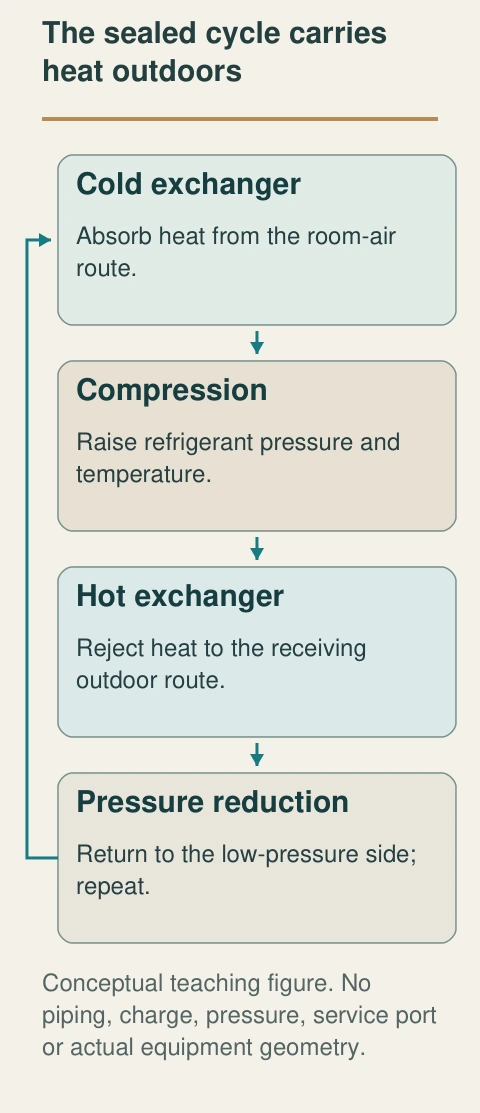
- Cold exchanger
Absorb heat from the room-air route.
- Compression
Raise refrigerant pressure and temperature.
- Hot exchanger
Reject heat to the receiving outdoor route.
- Pressure reduction
Return to the low-pressure side; repeat.
What does this illustration leave out?
No piping, charge, pressure, service port or actual equipment geometry. This illustration explains an idea. It is not an installation guide.
Can the provider identify the cold-side air, hot-side air and sealed refrigerant routes for this unit?
Explore this with HomeAI ↗Opens an editable question. Nothing is sent until you choose to send it.Three routes with different jobs
- Room airPasses over the cold exchanger and returns to the occupied space.
- Sealed refrigerantTransfers heat through the cycle without entering room air.
- Heat-rejection airReceives heat at the hot exchanger and carries it outside the cooled space.
Conceptual cycle; no internal geometry or service procedure.
Further reading: Natural Resources Canada · Air Conditioning Your Home.
Read the complete figure
The sealed cycle carries heat outdoors
Refrigerant absorbs heat at the cold exchanger, passes through compression, releases heat at the hot exchanger and returns through pressure reduction. Room and heat-rejection air remain separate routes.
- Cold exchanger
- Absorb heat from the room-air route.
- Compression
- Raise refrigerant pressure and temperature.
- Hot exchanger
- Reject heat to the receiving outdoor route.
- Pressure reduction
- Return to the low-pressure side; repeat.
What remains unknown: No piping, charge, pressure, service port or actual equipment geometry.
A useful question: Can the provider identify the cold-side air, hot-side air and sealed refrigerant routes for this unit?
What is different about a window unit?
A window unit’s room side draws in room air and returns the cooled stream. Its outdoor side rejects heat to outdoor air. The two sides belong to one appliance, but that does not mean all air passes straight through from outside to inside. Any ventilation feature has its own model-specific arrangement and should not be assumed from the word window.
The contextual cutaway locates a closed unit across an exterior opening. It teaches the room/outdoor boundary, not a fastening or support detail. The unit’s weight, permitted opening, support, weather seal and access need to follow the actual instructions and appropriate building arrangements. Do not balance a unit on an improvised shelf to reproduce the illustration.
Window mounting and through-wall mounting are also different product/application questions. A unit intended to use side openings may not behave as intended when those openings are concealed in a wall sleeve. Have the provider identify the actual model and approved application instead of assuming every rectangular room unit fits any opening.
Consider the opening’s other jobs. Light, ventilation, security, weather protection and any required escape function can matter to the proposed placement. Ask the relevant building professional, owner or management about the actual opening and local requirements. This guide does not approve blocking an exit or modifying a window frame.
Record the model, installation and seasonal instructions together. A secure-looking photograph does not establish the support behind the frame. If the unit is loose, damaged, leaking toward electrical equipment or otherwise presents an apparent hazard, stay clear and arrange appropriate help. Heavy-unit removal is not an owner test of whether a different location cools better.
A window unit places room and outdoor jobs across an opening
The closed unit’s room face and outdoor body span the conceptual exterior plane. The room side circulates cooled air; the outdoor side rejects heat through its own route.
Numbers identify the parts explained below.
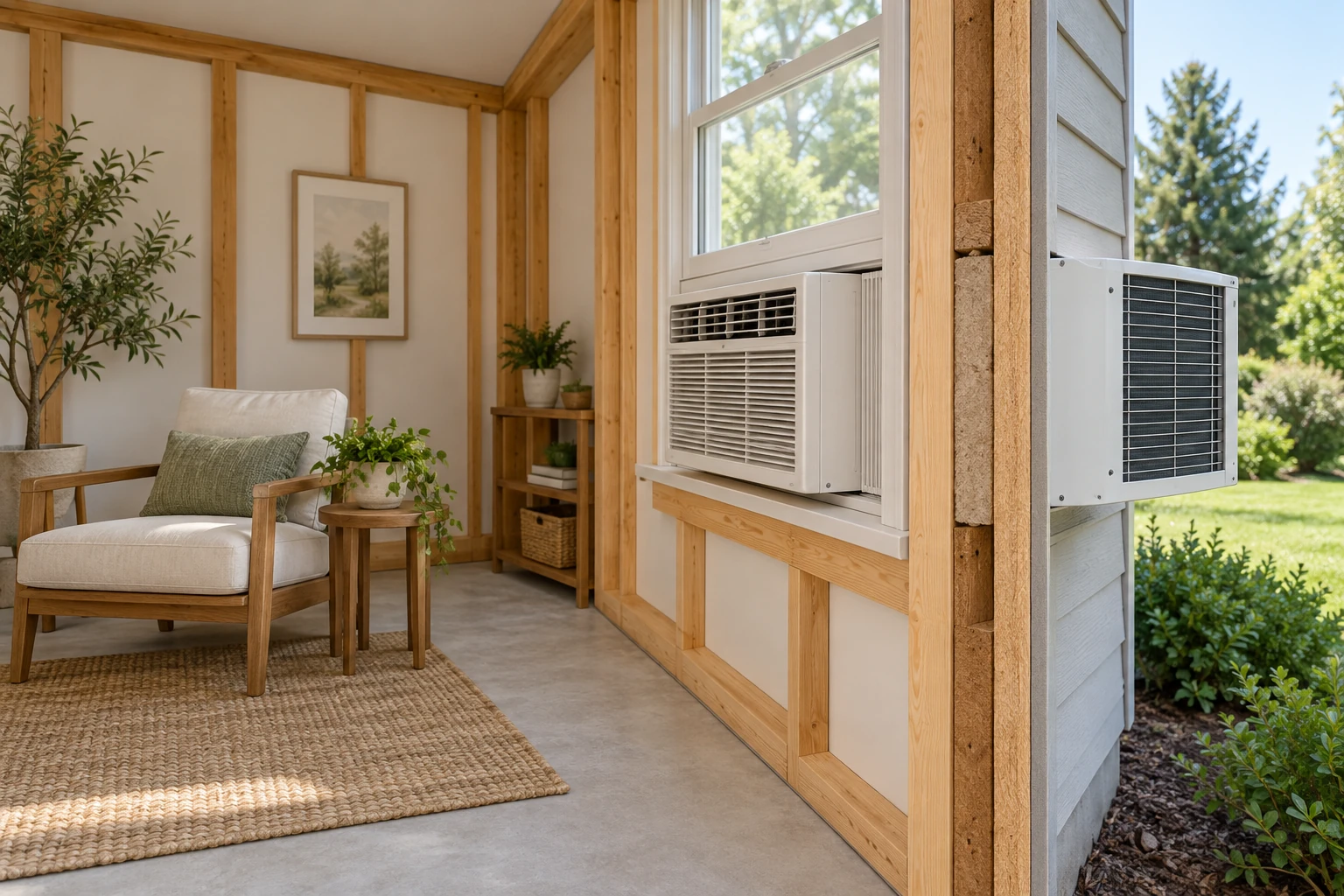
- Room face
Receives room air and returns the cooled stream under actual operation.
- Exterior plane
Separates occupied space from the outdoor heat-rejection destination.
- Outdoor body
Keeps the hot-side route outside the cooled room.
What does this illustration leave out?
No support, seal, escape-opening compliance, wiring, internal geometry or measured performance. This illustration explains an idea. It is not an installation guide.
Which actual model and opening arrangements establish the complete installation scope?
Explore this with HomeAI ↗Opens an editable question. Nothing is sent until you choose to send it.Why does a single-duct portable unit need room replacement air?
NRCan defines a single-duct portable unit by its condenser-air route: it takes that air from the conditioned space and discharges it outside through one duct. The room-cooling circulation is a separate function. Some room air therefore leaves with the heat-rejection stream instead of remaining entirely within the room.
Air leaving a space has to be replaced through the building’s available routes. The exact native diagram shows an outgoing heat-rejection arrow and a separate replacement-air arrow from an unspecified surrounding source. It does not claim which crack, doorway or vent supplies the actual home. That source and the building’s pressure interactions need suitable assessment where relevant.
Replacement air can affect the room’s heat balance under actual conditions. This does not establish that every single-duct product performs identically or that a particular unit is faulty. Compare ratings for the identified configuration and discuss the actual room. A simple drawing cannot calculate infiltration, cooling capacity or interaction with other building equipment.
Keep the supplied duct and window arrangement within the model instructions. Do not extend or substitute a hose, seal required building ventilation or alter combustion-air provisions to chase a colder stream. Ask a qualified cooling/building provider when installation or pressure interactions are unclear. The actual manual and site determine what is suitable.
The single-duct picture shows only the visible arrangement, with the actual heat and air relationship explained beside it. Its window panel is conceptual. A room that remains warm could involve heat gains, room boundaries, airflow, setup, controls or equipment; the duct count alone cannot select the cause or justify replacement.
The single duct carries heat-rejection air outdoors
A closed portable unit connects through one visible exhaust duct to the window panel. The exact native figure separately explains room cooling and replacement air.
Numbers identify the parts explained below.
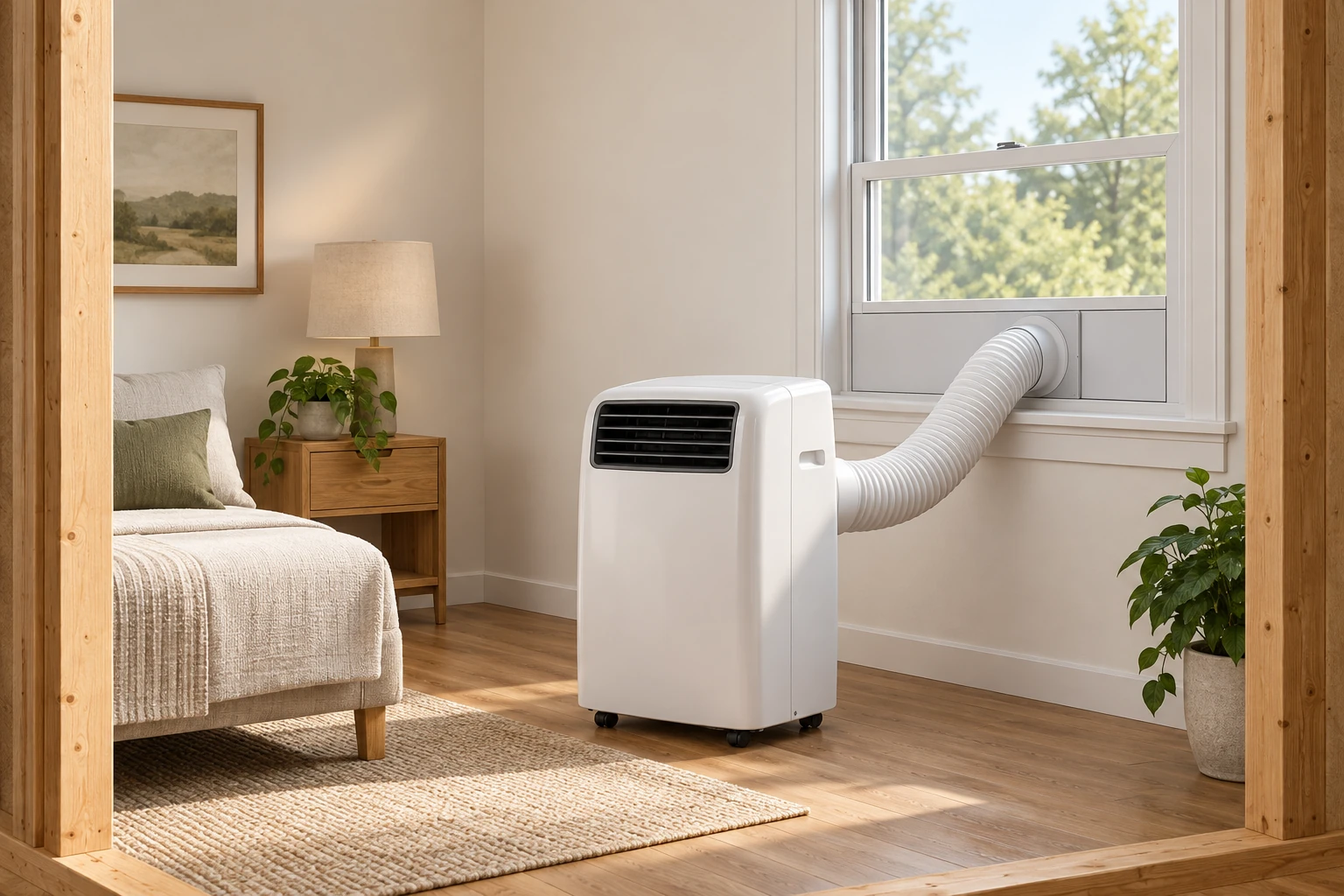
- Closed portable unit
Contains distinct cooling and heat-rejection jobs.
- Single duct
Carries the condenser discharge route outside in this concept.
- Window interface
The actual product and opening need their own instructions and assessment.
What does this illustration leave out?
No hidden airflow geometry, support/seal approval, replacement-air source, rating or pressure result. This illustration explains an idea. It is not an installation guide.
Where does this model take condenser inlet air, and which rating configuration applies?
Explore this with HomeAI ↗Opens an editable question. Nothing is sent until you choose to send it.What changes with a dual-duct portable unit?
NRCan’s dual-duct definition says some or all condenser inlet air comes from outside through a duct, and condenser outlet air leaves outside through another route. The word some matters. Do not turn the label into a promise that every product is perfectly sealed from room air or has no building-pressure effect.
The native comparison keeps room cooling and heat rejection separate for both configurations. The dual example shows an outdoor intake and outdoor discharge, while retaining an explicit model-dependent boundary. Some products package the two passages in a different visible shape. Counting flexible outer housings is not always a reliable way to identify the actual air paths; use the model documentation.
A second duct does not eliminate room heat gains, installation requirements or condensate. It also does not guarantee that the proposed unit can cool an entire apartment. Ask which configuration the ratings describe and what the room/use assessment supports. The highest-looking advertisement number is not a substitute for that comparison.
Use the supplied configuration and qualified instructions. Do not add an intake duct to a single-duct appliance, block a grille or modify a cabinet to imitate a diagram. Those changes alter equipment outside the educational scope. The exact native figures compare mechanisms, while the actual product and its applicable documentation govern the installation.
When discussing alternatives, keep the whole decision visible: compatible opening, support and seals, room area and gains, sound, electrical supply, maintenance and seasonal handling. This guide does not rank products or make a purchase recommendation. A meaningful comparison explains the jobs and limits before comparing price.
Two visible ducts serve a separate outside air arrangement
Two continuous ducts connect the closed portable unit to separate window-panel openings. The native comparison explains outside condenser intake and discharge while keeping room circulation distinct.
Numbers identify the parts explained below.
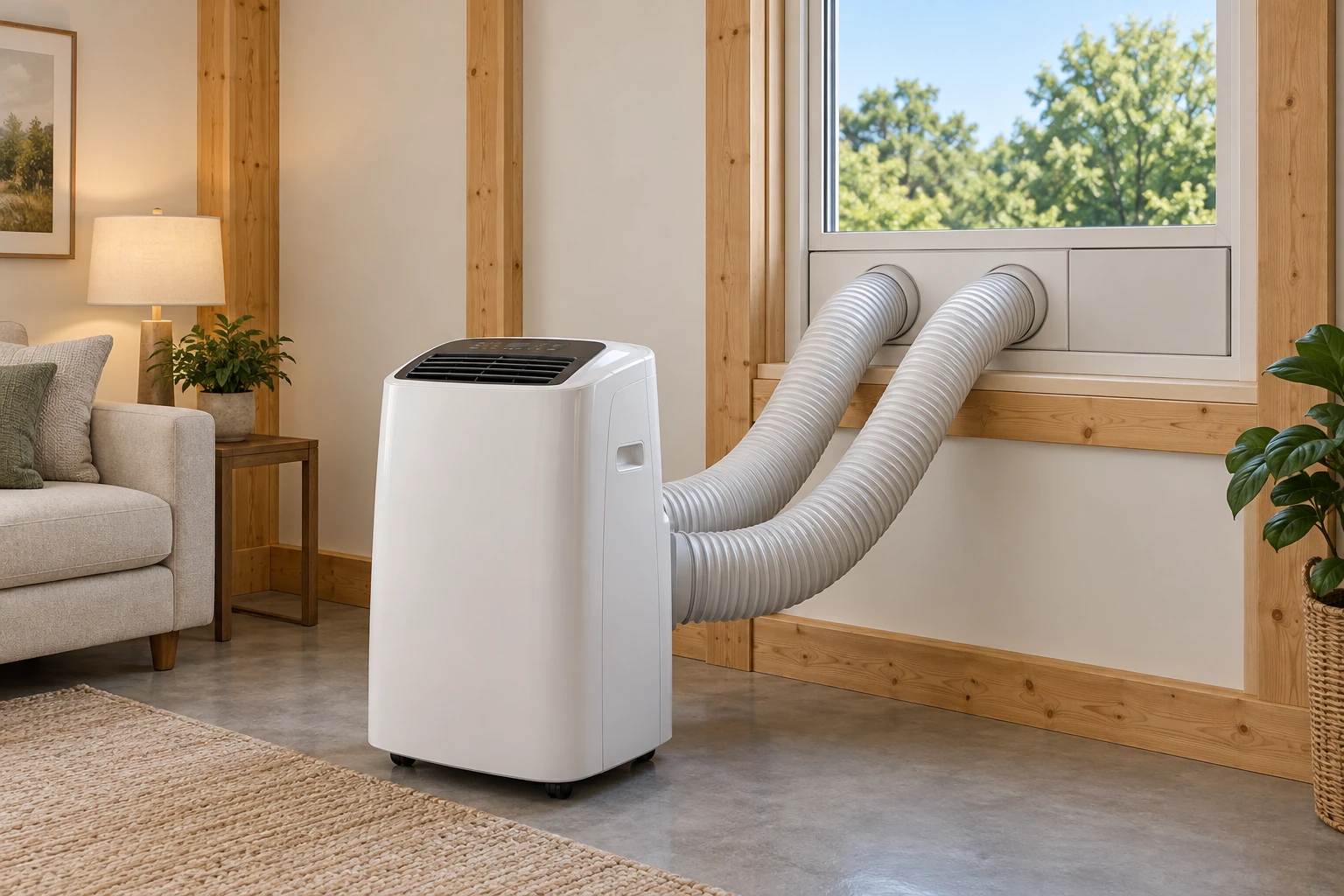
- Closed appliance
Room cooling remains a separate internal function.
- Two duct passages
Represent the distinct outside condenser-air routes.
- Window panel
Actual compatible setup and ratings remain model-specific.
What does this illustration leave out?
Duct direction is supplied by the conceptual native diagram, not visible casing; no exact model, mixing fraction, pressure or efficiency guarantee. This illustration explains an idea. It is not an installation guide.
Does the applicable documentation identify these actual inlet and outlet routes?
Explore this with HomeAI ↗Opens an editable question. Nothing is sent until you choose to send it.Compare the heat-rejection air paths
Single-duct condenser air comes from the conditioned space. A dual-duct unit takes some or all condenser inlet air from outdoors and discharges outdoors separately. Both retain a distinct room-cooling function.
Numbers identify the parts explained below.
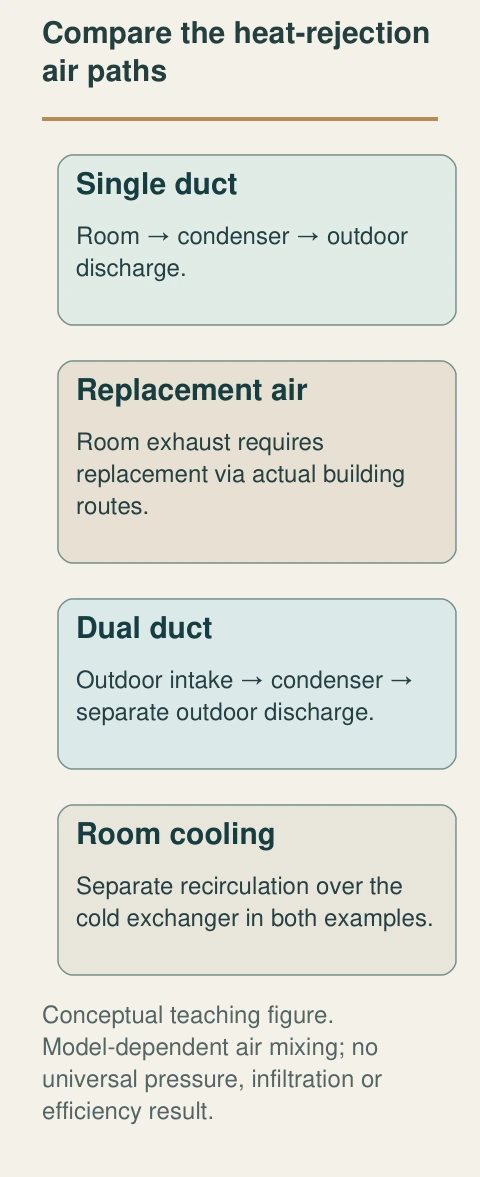
- Single duct
Room → condenser → outdoor discharge.
- Replacement air
Room exhaust requires replacement via actual building routes.
- Dual duct
Outdoor intake → condenser → separate outdoor discharge.
- Room cooling
Separate recirculation over the cold exchanger in both examples.
What does this illustration leave out?
Model-dependent air mixing; no universal pressure, infiltration or efficiency result. This illustration explains an idea. It is not an installation guide.
Which actual configuration and ratings describe this model’s complete air routes?
Explore this with HomeAI ↗Opens an editable question. Nothing is sent until you choose to send it.Compare the condenser-air arrangements
- Window unitRoom/outdoor sides located across the exterior opening.
- Single ductCondenser air from conditioned space leaves through its exhaust route.
- Dual ductSome or all condenser inlet air comes from outdoors; outlet air leaves outdoors separately.
Model-dependent routes; no universal pressure, efficiency or cooling guarantee.
Further reading: Natural Resources Canada · Portable air conditioners; Natural Resources Canada · Air Conditioning Your Home.
Read the complete figure
Compare the heat-rejection air paths
Single-duct condenser air comes from the conditioned space. A dual-duct unit takes some or all condenser inlet air from outdoors and discharges outdoors separately. Both retain a distinct room-cooling function.
- Single duct
- Room → condenser → outdoor discharge.
- Replacement air
- Room exhaust requires replacement via actual building routes.
- Dual duct
- Outdoor intake → condenser → separate outdoor discharge.
- Room cooling
- Separate recirculation over the cold exchanger in both examples.
What remains unknown: Model-dependent air mixing; no universal pressure, infiltration or efficiency result.
A useful question: Which actual configuration and ratings describe this model’s complete air routes?
Where does the condensed water go?
Condensate is liquid water formed as moisture from air reaches the cold exchanger under suitable conditions. The appliance must manage it according to its design and operating mode. It may use an internal collection arrangement, an approved drain option or another model-specific process. Do not assume all room units should drip continuously or all portables should remain completely dry.
The named Danby manual distinguishes a bottom tray from a continuous-drain option and describes a full-tray response in which cooling or dehumidification stops while the fan may continue. That is an exact-model example, not a universal error-code dictionary. A running fan therefore cannot by itself establish continuing moisture removal or cooling.
The condensate image keeps the appliance closed and the lower drain cover closed. It does not show an owner removing plugs or invent a hidden pump. The native water figure connects cold-surface condensation to model-specific management and the receiving question. Ask which port or arrangement applies to the actual mode and how the provider’s instructions address it.
Do not drill drain holes, tilt a unit, add chemicals or copy another model’s hose instructions. An unexplained leak near electrical equipment changes the response: stay clear and obtain appropriate help. If ordinary care is permitted by the exact manual, follow it only under its intact, safe conditions. The guide supplies no generic drain-operation procedure.
Record where water first appeared, mode, displayed message and any known recent move or work. Preserve the distinction between appliance condensate, room humidity and water entering at the window opening. They can occur in the same area without having the same cause. A useful service request describes them separately.
Condensate follows the model and operating mode
Air moisture can condense at the cold exchanger. The actual appliance manages that water through its defined arrangement; a full-collection response can stop cooling while a fan continues in a named model.
Numbers identify the parts explained below.
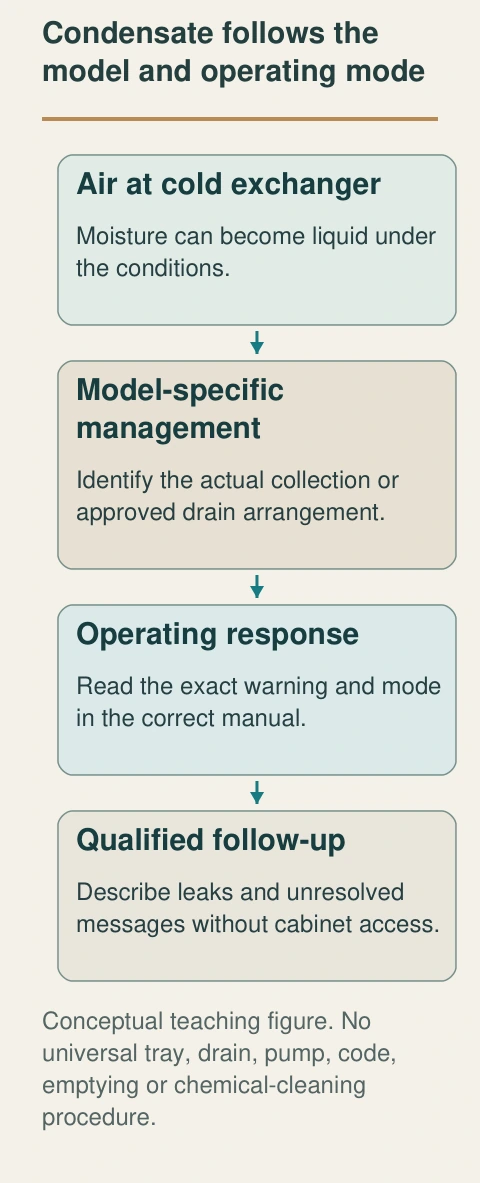
- Air at cold exchanger
Moisture can become liquid under the conditions.
- Model-specific management
Identify the actual collection or approved drain arrangement.
- Operating response
Read the exact warning and mode in the correct manual.
- Qualified follow-up
Describe leaks and unresolved messages without cabinet access.
What does this illustration leave out?
No universal tray, drain, pump, code, emptying or chemical-cleaning procedure. This illustration explains an idea. It is not an installation guide.
What does the applicable manual say about this mode, exact message and water-management arrangement?
Explore this with HomeAI ↗Opens an editable question. Nothing is sent until you choose to send it.Read the complete figure
Condensate follows the model and operating mode
Air moisture can condense at the cold exchanger. The actual appliance manages that water through its defined arrangement; a full-collection response can stop cooling while a fan continues in a named model.
- Air at cold exchanger
- Moisture can become liquid under the conditions.
- Model-specific management
- Identify the actual collection or approved drain arrangement.
- Operating response
- Read the exact warning and mode in the correct manual.
- Qualified follow-up
- Describe leaks and unresolved messages without cabinet access.
What remains unknown: No universal tray, drain, pump, code, emptying or chemical-cleaning procedure.
A useful question: What does the applicable manual say about this mode, exact message and water-management arrangement?
Does fan, dry or automatic mode mean the same as cooling?
A fan mode moves air according to the appliance’s controls without necessarily operating the refrigeration cycle. A dry mode has its own moisture-removal behaviour and drainage requirements. Automatic mode selects functions according to the actual model’s logic. Those labels should be read in the correct manual rather than treated as interchangeable ways to demand maximum cooling.
The named Danby example explains distinct mode and display states. Its display can show a target, timer information, a code or a room reading depending on operation. A photograph of one number without the mode can therefore be misleading. Record what the control actually displays and ask the provider to explain unfamiliar states.
The retained manual also contains boilerplate references to heat even though its model-specific page says no heat mode. This guide withholds heating capability and related instructions for those models. A current reachable manual can contain inconsistent text; preserving that limit is more useful than inventing a feature to make the pages agree.
Timers, sleep functions, remote sensing and restart behaviour also vary. A device may operate differently after a schedule, remote signal or power event. Obtain the exact instructions and record relevant ordinary states. Do not repeatedly power-cycle, reset wireless settings or trigger error conditions as a substitute for qualified investigation.
A control explanation should leave the household able to distinguish airflow, active cooling, moisture management and a displayed warning. Ask which functions were demonstrated at handover. A brief cold stream under one setting does not establish every mode or an all-night room-temperature outcome.
How should I compare capacity and efficiency labels?
Cooling capacity describes a rate of heat removal under defined conditions. Efficiency relates a cooling result to energy input using the stated metric and test method. A larger capacity number and a higher efficiency rating answer different questions. Keep the product, model and configuration with each number before comparing them.
NRCan’s current portable guidance distinguishes seasonally adjusted cooling capacity, SACC, and combined energy efficiency ratio, CEER, including applicable configurations. A retailer may show more than one capacity convention. Do not treat unlike numbers as two measured results for the same room. Ask which metric and test basis the advertised value uses.
A label describes a product under its defined rating arrangement; room behaviour also depends on heat gains, weather, boundaries, setup and use. A suitable sizing discussion considers the actual room and intended conditions. This guide adopts no floor-area shortcut, required capacity, efficiency minimum formula or guaranteed bill saving.
The current NRCan guidance has a manufacture-date scope and is an administrative document, not legal advice. Its existence does not establish a particular used unit’s original label obligations or current condition. Keep the actual nameplate, packaging/label records where available and the provider’s explanation for the model being considered.
The legacy NRCan cooling page remains useful for the physical cycle, but its older EER/SEER and ENERGY STAR threshold passages are not used as current shopping guidance here. Dates and scope belong beside a comparison. A modern page footer should not silently refresh every historical claim in its body.
Do not compare unlike numbers
- Cooling capacityRate of heat removal under the stated method.
- SACCSeasonally adjusted portable capacity for the identified configuration.
- CEEREfficiency metric, not an additional capacity value.
- Observed room resultActual conditions and use; not established by a label alone.
No sizing, savings forecast or legal interpretation.
Further reading: Natural Resources Canada · Portable air conditioners.
What can I observe when a room stays warm?
Begin with the room and timing: where discomfort occurs, when sunlight reaches the room, whether doors connect other spaces and what ordinary equipment is running. Add the appliance model, mode, visible setup and displayed state. These observations help distinguish a room-load question from an airflow, control, condensate or equipment question without selecting a fault.
Use only ordinary safe observations around intact equipment. Do not open covers, probe grilles, extend ducts or bypass protection. A damaged cord, burning smell, smoke, wet electrical area or unstable unit requires an appropriate urgent response. An active fire calls for leaving and emergency help; do not stay to complete a temperature log.
Visible obstructions and the actual manual’s care instructions can be relevant, but a generic online cleaning interval is not the authority for every unit. Have the provider explain which routine care is suitable and which work needs service. This guide supplies no refrigerant check, coil cleaning, electrical test or chemical treatment.
When comparing days, keep weather and use differences visible. A room that feels better after a cloudy afternoon has not demonstrated the isolated effect of a changed setting. A reading near the outlet differs from the occupied location. Ask the qualified assessor which observations are meaningful for the intended decision rather than collecting decorative numbers.
Cooling equipment can be part of a broader heat plan, but an unresolved cooling problem should not delay obtaining a suitable cooler place or current local health advice when conditions require it. The existing overheating guide connects those wider questions. No temperature here is supplied as a medical safety threshold.
A cold grille does not answer the entire room question
Room heat gains, equipment state and complete installation can all affect observed comfort. The service request should distinguish those questions before treating a larger rating as the solution.
Numbers identify the parts explained below.
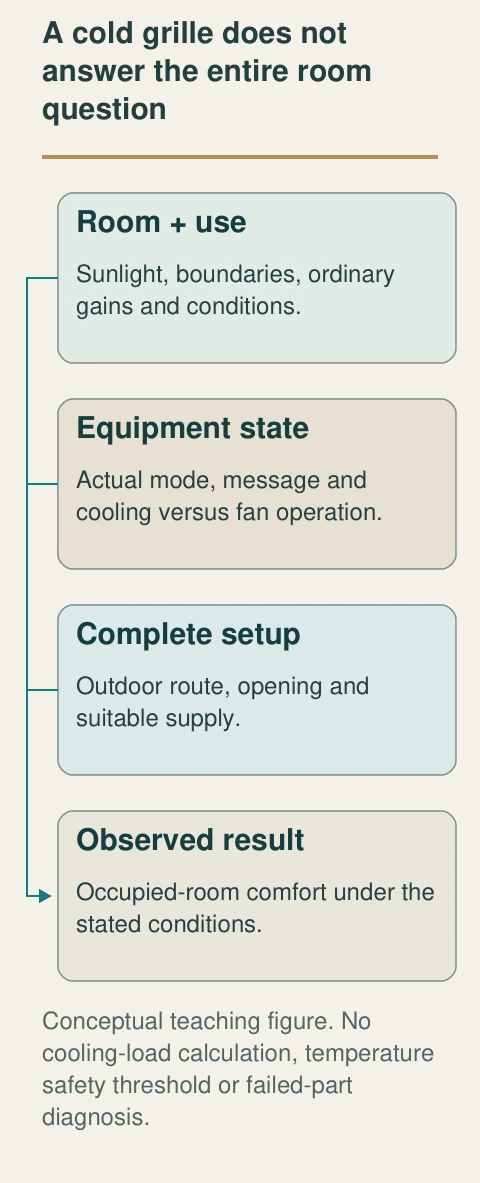
- Room + use
Sunlight, boundaries, ordinary gains and conditions.
- Equipment state
Actual mode, message and cooling versus fan operation.
- Complete setup
Outdoor route, opening and suitable supply.
- Observed result
Occupied-room comfort under the stated conditions.
What does this illustration leave out?
No cooling-load calculation, temperature safety threshold or failed-part diagnosis. This illustration explains an idea. It is not an installation guide.
Which room, setup and equipment findings support the actual remedy?
Explore this with HomeAI ↗Opens an editable question. Nothing is sent until you choose to send it.Read the complete figure
A cold grille does not answer the entire room question
Room heat gains, equipment state and complete installation can all affect observed comfort. The service request should distinguish those questions before treating a larger rating as the solution.
- Room + use
- Sunlight, boundaries, ordinary gains and conditions.
- Equipment state
- Actual mode, message and cooling versus fan operation.
- Complete setup
- Outdoor route, opening and suitable supply.
- Observed result
- Occupied-room comfort under the stated conditions.
What remains unknown: No cooling-load calculation, temperature safety threshold or failed-part diagnosis.
A useful question: Which room, setup and equipment findings support the actual remedy?
Who should assess installation, supply and equipment?
The installation question concerns opening compatibility, support, seals, required access and the complete outdoor route. Electrical supply and protection need the appropriate qualified electrical scope. Refrigeration faults need suitable service personnel. Building management or the owner may also be involved where openings and shared elements are controlled.
Ask the provider which questions the visit covers and what remains excluded. A refrigeration service appointment may not assess a window’s support or the building’s pressure relationships. An electrician’s supply finding does not establish room sizing. A clear responsibility map prevents one invoice from becoming evidence for every part of the cooling arrangement.
Provide actual equipment identity, instructions, installation records and the dated symptom account. Retain model-specific warnings and any recall information relevant to that identity. This guide makes no claim that a recall search has cleared an unspecified appliance. Exact identity is needed before a manufacturer notice can be matched.
If replacement is proposed, ask what supported finding it addresses and how the alternative fits the room and opening. Compare scope and future responsibilities along with price. A different duct configuration can change the air route while leaving other causes of overheating unresolved. No product recommendation or repair price is supplied here.
After actual work, request completed installation/service records, relevant local documents and a handover of ordinary use and fault response. Identify what was demonstrated, under which conditions, and what still needs follow-up. Keep the earlier report rather than replacing it with a single line that the unit was upgraded.
How do a fan, a dehumidifier and an air conditioner change the room differently?
A fan’s immediate job is to move air. That can change how a person experiences the room without creating the same heat-removal route as an air conditioner. A room air conditioner transfers heat outside the cooled space through its designed arrangement. These are different mechanisms, so air movement at a grille is not sufficient evidence of active room cooling.
A dehumidifier’s intended job is moisture management under its actual instructions. A room air conditioner may also collect moisture while cooling, but its purpose and complete outside heat-rejection route are different. Water collection alone therefore does not identify a cooling result or make the appliance functions interchangeable. Keep the intended outcome and the actual operating mode together in the record.
The existing dehumidifier guide follows air, heat and water through that separate appliance. Use it when the primary question is indoor moisture rather than summer heat removal. A device marketed with several modes still needs its actual mode-specific instructions. Do not assume that dry mode is simply a quieter name for the same cooling operation.
For the named Danby example, operating-mode and drainage text must be read together. This guide intentionally does not provide a universal rule for attaching or removing exhaust in every dry mode. Another product can have a different arrangement. A household should follow the applicable manual or qualified advice rather than copy a diagram made for a different mode.
The room’s moisture source remains a separate question. Collecting appliance water does not prove a wall leak is repaired or that every concealed material is dry. Conversely, a warm room does not establish excessive moisture or a failed drain. Describe the actual complaint and relevant observations before selecting which appliance or professional scope fits it.
A proposed remedy should state the outcome it is meant to achieve. Is the aim air movement at an occupied spot, moisture management under specified conditions or heat removal from the room? Compare alternatives against that same goal. A purchase decision based only on the presence of a fan, water tray or large cooling number can compare unlike jobs.
Keep the whole-home context in view without asking one appliance to certify it. Ventilation, moisture sources, summer gains and permanent heating/cooling have distinct requirements. Do not block required vents or alter another system to improve an appliance’s apparent result. A qualified review can coordinate those questions while the household retains a clear record of the intended outcome.
How can two cooling comparisons accidentally answer different questions?
Imagine two clearly fictional product cards. One displays a large generic cooling-capacity number; another prominently displays SACC and CEER. Without their methods and configurations, the numbers cannot be ranked as if they all measured the same thing. The first task is to identify what each field describes, not select the larger font.
Even two capacity values need matching units and rating bases. A capacity is a rate of heat removal, while electrical consumption over a period is energy. CEER is an efficiency metric rather than another amount of cooling or electricity. Keep each original label and its explanation instead of copying the numbers into an unlabelled comparison column.
For a portable product with configuration options, use the actual configuration being proposed. NRCan’s administrative guidance asks for applicable SACC and CEER information for those arrangements. A rating from a different option should not silently become the expected result of the installation in the household’s room.
Room observations introduce another basis. A cold outlet stream measured or felt briefly differs from the occupied room’s conditions over a period. A provider can choose appropriate measurements for the decision. This guide supplies no owner temperature-difference test or universal service threshold. Record the observation accurately without giving it a broader meaning.
Weather and room use can also change a before-and-after comparison. Different sun, doors, occupancy or equipment gains can influence the result. A favourable afternoon after replacement is useful as a dated observation; it does not isolate the replacement’s effect or establish every future hot-day condition. Ask what further assessment is warranted for the actual concern.
The same discipline applies to sound and controls. A sound claim may describe a particular mode or method, while the household’s concern occurs during another operating state. A timer or remote feature may be described without a complete demonstration. Retain the method and conditions rather than treating each brochure field as a guaranteed room experience.
Keep reported and measured results separate as well. A household can accurately report that one room felt better while a provider records a narrower measured condition. Neither account needs to be discarded, but their methods differ. When the proposal claims to solve the original concern, ask how its evidence connects to the occupied room and period that prompted the request. A number copied from a label should retain its product-rating identity rather than being relabelled as that household’s actual performance.
A useful comparison ends with a decision-specific explanation: which option fits the room, opening, supply and operating responsibilities, and what evidence supports that view. Price can then be considered alongside the actual scope. This guide invents no product rating, measured sound result, required capacity or saving to make the fictional cards look complete.
What seasonal and Canadian limits should remain visible?
A seasonal room unit has storage, handling and window-restoration instructions for its actual model. The appliance and the opening are separate responsibilities. Removing a portable window kit does not by itself establish the window’s weather performance, while leaving a unit in place through winter may conflict with its instructions or building arrangements.
The exact Danby manual is printed March 2023 and concerns three named models. Its operating examples are not instructions for every portable or window appliance. The retained English safety and operation sections are adopted within stated limits; specialist service sections and translations are not claimed fully read. The heating-text conflict is preserved as a hold.
NRCan’s portable administrative page was modified October 2025. Its single/dual definitions and rating terms do not approve a particular installation. Provincial electrical, building and energy requirements can differ, as can rental or condominium arrangements. Ask the appropriate current local professional or authority for the actual scope.
The NRCan room-cooling body has a January 2025page date but retains clearly older regulatory and efficiency material. Only its complete mechanism and general assessment roles are adopted. No old threshold, sizing shortcut, refrigerant generalization or maintenance interval is presented as newly current advice.
The pictures and diagrams explain closed equipment and causal routes. They establish neither safe installation nor measured performance. The next household is fictional. Keep actual model, room, climate, date, configuration and limits together whenever a proposal or service result is used to support a decision.
How would a fictional household explain a warm room and a water warning?
In this invented case, Jules has a portable air conditioner in a sunny bedroom. The fan runs, the room remains warm and an unfamiliar display appears. Jules has the model identity but no recent service record. The initial account does not name a failed compressor, inadequate capacity or drain blockage.
Jules records the ordinary mode, exact displayed message, visible window/duct arrangement and known room conditions without opening the cabinet. The actual manual is obtained. If the message concerns collected water in that exact model, the household follows the appropriate safe provider/manufacturer advice; this story supplies no generic drain procedure.
One hypothetical investigation branch concerns the equipment’s condensate or operating state. Another concerns the room heat gains, setup or suitability. These can coexist, so the appointment asks which questions the provider can assess. A fan that continues after cooling stops is not taken as proof of refrigeration operation.
The invented service note identifies the displayed condition as a collected-water stop under the named model’s instructions, with the fan able to continue. It does not assess the bedroom’s cooling load or the window arrangement. Jules therefore separates a model-specific operating response from a proposal to replace the unit for being too small. The provider must address the water-management task within the actual instructions, while room suitability needs its own evidence. No owner draining procedure, refrigerant diagnosis, code number or successful repair is supplied.
If replacement is considered, Jules compares like rating metrics and the actual window arrangements rather than choosing the largest advertisement number. A dual-duct alternative changes the heat-rejection route; the room’s sunlight and other gains remain part of the decision. The household’s broader heat plan stays connected to current local advice.
The useful outcome is an understandable chain from room air through heat removal, outdoor rejection and water management, with each actual finding attached to the question it answers. A colder grille is not the entire result. The record should explain the room, equipment and remaining task well enough for another provider to continue without guessing.
Keep learning about the connected parts
- How a heat pump moves heat: the cycle, rooms and energy numbers
- Understand why a home holds summer heat
- Dehumidifiers: understand the air, heat and collected water
- Why does a breaker trip? Understand GFCI and AFCI protection
- Build a home-care record that the next person can understand
Canadian context and authorities · Visual atlas · Learning labs
Practice the distinction.
Jules separates a water warning from a warm room
Fictional case: a portable fan runs while a sunny room stays warm and an unfamiliar message appears.
Reported observations
- The fictional service note matches the displayed condition to a collected-water stop for the named model.
- The note excludes bedroom cooling-load and window-arrangement assessment.
- The cabinet remains closed and no duct, drain or interruption experiment occurs.
Compare the explanations
Expand each possibility to see the evidence needed to distinguish it. Similar symptoms can have different mechanisms.
An operating or condensate condition
The exact model may stop cooling while airflow continues.
Applicable instructions and qualified model-specific findings.
Room or setup contributes
Heat gains, boundaries and installation can ask a distinct assessment question.
Use-matched room/setup review and like-metric comparison.
A useful next question
Address the model-specific water-management task through the responsible provider, and request a separate room/setup assessment before accepting a capacity-based replacement proposal.
No real fault, code interpretation, refrigerant reading, price or successful cooling result is invented.
Know what the words mean.
- Evaporator
- The cold-side heat exchanger where refrigerant absorbs heat from the room-air route.
- Condenser
- The hot-side heat exchanger where refrigerant rejects heat to its receiving air route.
- Condensate
- Liquid water formed from air moisture on a sufficiently cold surface under the operating conditions.
- SACC
- Seasonally adjusted cooling capacity: a portable-unit rating under its defined method and configuration.
- CEER
- Combined energy efficiency ratio: a rating distinct from cooling capacity.
Questions to bring
to the conversation.
- What model and duct configuration are installed?
- Where do room air, rejected heat and condensate each go?
- What does the display mean in the actual mode?
- Are rating metrics and configurations comparable?
- Who covers support, electrical supply, equipment and room suitability?
Separate a showing observation, an existing record and a new professional assessment. Unknown means a question remains; it does not automatically mean a defect.
Use the evidence planner ↗Go to the source.
Original HomeAI explanation informed by these public references. Sources support the underlying guidance; they have not reviewed or endorsed HomeAI. Diagrams are conceptual, and calculator outputs depend on your inputs.
Current NRCan portable body and complete room-unit mechanism/assessment section read October 13, 2026; older efficiency/regulatory passages excluded. Exact Danby2023.03.23manual retained with stated English extent and heat-text contradiction held. No refrigerant/electrical service, reset, drain operation, drilling, tilt, chemicals, hose modification, support installation, universal capacity, pricing, purchase recommendation or code approval. Draft authorship remains separate from independent visual/editorial acceptance and publication.
Publication & source review
First published .
Sources reviewed .
Have a question about your home?
Start with the symptom, timing and what you have observed.
Ask HomeAI