- Identify incoming service, indoor supply and drainage separately; one visible pipe does not describe all three.
- Material identity, present condition, replacement extent and water-quality findings need different evidence.
- Obtain a current property-specific insurance response using the actual application facts and policy documents.
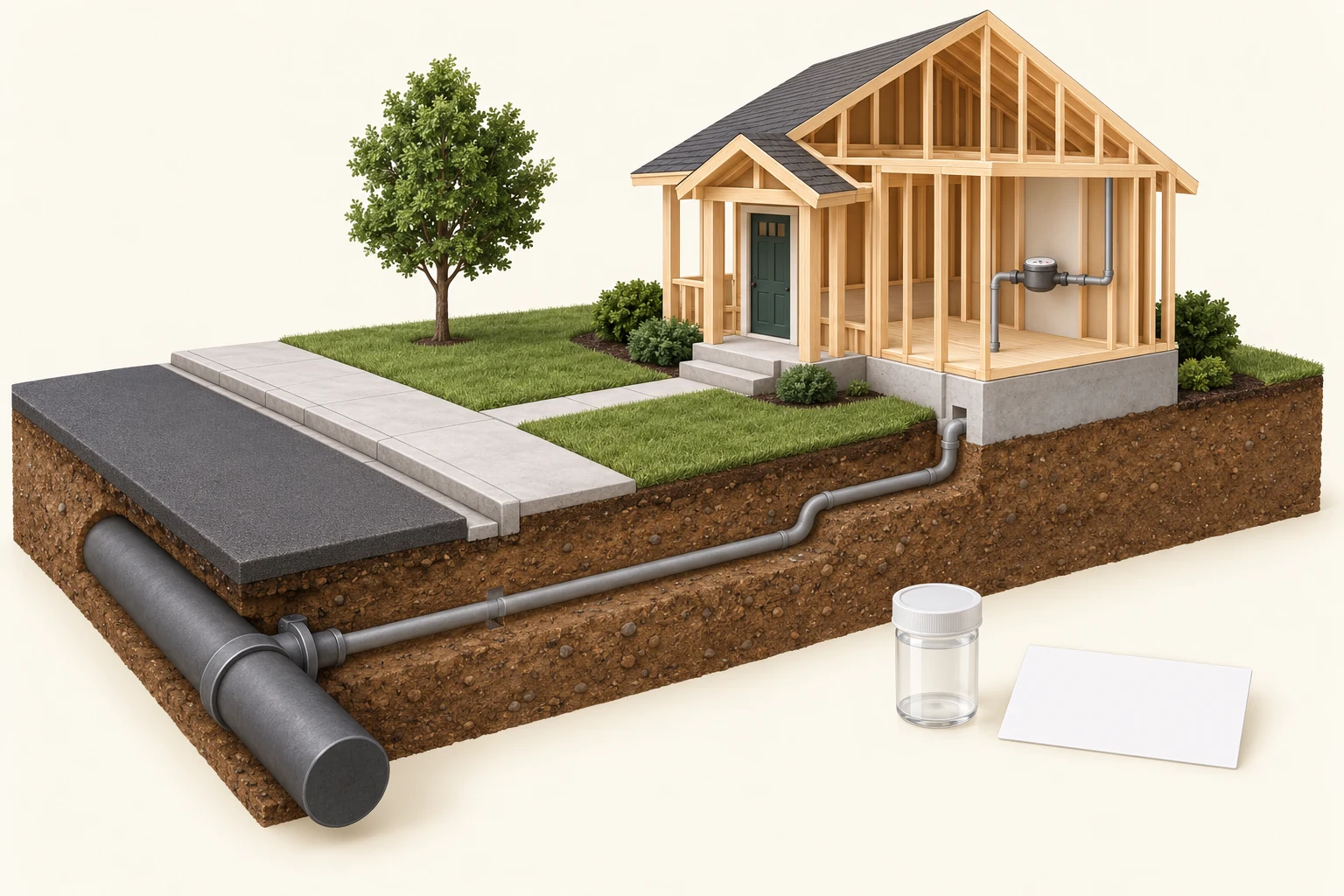
The large water main carries the street’s supply. A smaller service line brings water across the yard into the house, where a meter measures water use. Following these parts helps you locate the home’s water entry and match a repair record to the section of pipe it actually describes.
About this illustration
The pipe depths, sizes and grey colour are illustrative. Use property-specific records to establish real locations, materials and who maintains each section. Part of the indoor connection is hidden; no water-test result, measured pressure or winter protection is shown. This is a conceptual teaching model, not an assessment of your home.
5 picture lessons appear beside the questions in this guide. Use them to understand the explanation, then consider what it means for your home.
What does updated plumbing actually include?
Start with the work boundary. A listing may use updated plumbing for a kitchen renovation, a new water heater or an extensive supply replacement. Ask which network changed, the rooms or routes covered, the date and the available supporting documents. A precise statement such as kitchen supply branches replaced gives the buyer something to verify; a whole-house adjective leaves the boundary unstated.
Build a simple record with separate columns for seller-reported, documented and professionally identified. Attach the invoice or finding to the relevant route. Record exclusions with the same care as completed work. A contractor who worked inside one bathroom may have no basis for describing the service under the yard or a branch concealed above another ceiling.
This matters for sellers too. A carefully bounded description can show the value of completed work without accidentally promising more. Preserve earlier records when later work changes the system. The useful question is how each document relates to the present installation, rather than whether the folder contains enough reassuring pages.
Which network does the material belong to?
Keep the incoming water service, indoor water supply and drain-waste-vent system on separate lines of the file. Supply delivers water to fixtures; drainage and venting perform different functions. IPEX identifies its named Drain-Way ABS product as a drain, waste and vent system. That is a useful application distinction, without establishing that every dark plastic pipe in a photograph is that product.
A report of copper supply does not identify the drainage stack. A visible plastic drain does not establish the buried incoming service. A sewer-camera report follows a wastewater route and does not identify the material of the separate water service. Request the appropriate specialist scope when the unresolved question changes from one network to another.
Add the location as well as the material name: service entering the building, exposed basement supply, bathroom branch or drainage stack. This prevents a true observation about one component from becoming an unsupported assertion about the home. Shared-building and private-well questions also need their own responsibility and source records.
Water comes in; used water leaves through a different system
Supply pipes bring water to taps and appliances. After use, water leaves each sink through a drain and trap before joining the larger drainage route. The trap holds a water seal that limits gas passage into the room. Venting lets air circulate in the drainage system and helps protect those seals. Following these different jobs makes a repair record much clearer than calling everything plumbing.
Numbers identify the parts explained below.
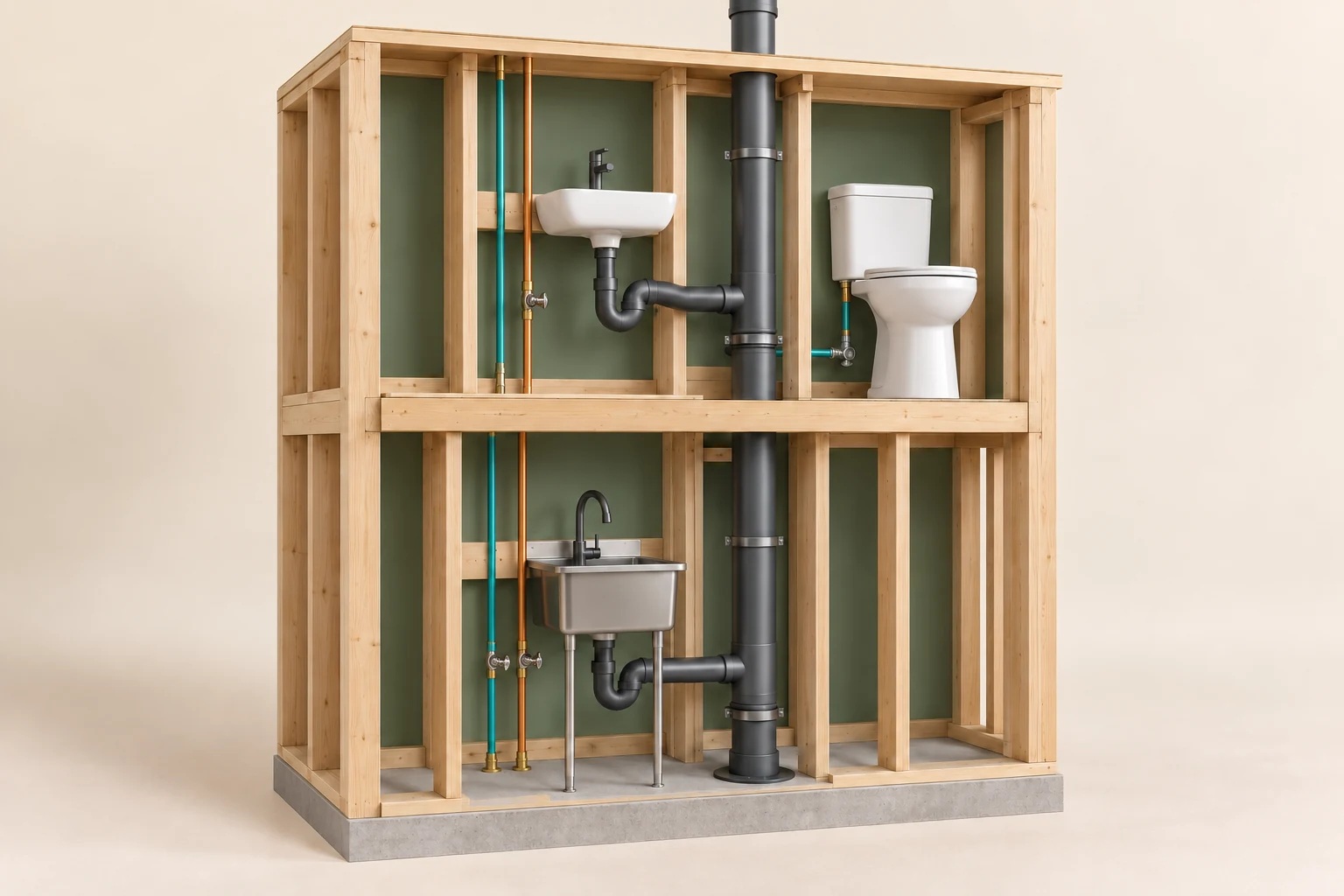
- Water supply
The narrow runs illustrate water delivery to fixtures. Incoming pressure provides the push; the drains carry used water away separately. A supply replacement record should name the branches and endpoints it covers.
- Sink trap
Water retained in an installed trap forms a barrier against gas from the drain. The curved shape helps locate that part here, but the picture does not show its retained water or establish its condition.
- Drainage and venting
The larger vertical pipe illustrates a stack carrying drainage between floors. Venting has the separate air-circulation and trap-protection job. Ask where each fixture drains and how its trap is vented; those complete connections are not drawn.
What does this illustration leave out?
The cutaway omits the tap connections, water inside the traps and a complete vent route to outside air. Pipe colour does not identify material. Ask a qualified plumber to explain the actual arrangement; this picture supplies no local design or approval. This illustration explains an idea. It is not an installation guide.
Which pipes supply this fixture, where does its used water go, and how does the actual vent arrangement protect its trap seal?
Explore this with HomeAI ↗Opens an editable question. Nothing is sent until you choose to send it.Follow the water from the street into the house
The large water main carries the street’s supply. A smaller service line brings water across the yard into the house, where a meter measures water use. Following these parts helps you locate the home’s water entry and match a repair record to the section of pipe it actually describes.
Numbers identify the parts explained below.
- Street water main
The main carries the neighbourhood’s water supply along the street. The smaller service line branches from it to supply this illustrated home. Ask the utility which part of your real connection its records describe.
- Service line across the yard
The service line brings water to the house. Different sections may have different materials or replacement histories, so ask where each recorded section starts and ends. The drawing does not mark the local maintenance boundary.
- House entry and meter
The service enters the building; the meter measures water use. Indoor supply branches continue toward fixtures but are not drawn here. For winter planning, ask where the actual entry and nearby pipes sit in relation to heated space.
What does this illustration leave out?
The pipe depths, sizes and grey colour are illustrative. Use property-specific records to establish real locations, materials and who maintains each section. Part of the indoor connection is hidden; no water-test result, measured pressure or winter protection is shown. This illustration explains an idea. It is not an installation guide.
Where does this home’s service line enter, which sections were identified or replaced, and who maintains each one?
Explore this with HomeAI ↗Opens an editable question. Nothing is sent until you choose to send it.What establishes a pipe material’s identity?
Useful identification records name the observed component, location, accessible extent, method and limitations. Existing photographs of legible product markings can support the record when a qualified professional interprets them. Alberta’s historical Poly-B bulletin explains that pipe markings can include the material designation and product information. Markings are evidence about the marked product; their meaning and connection to an entire installation still require context.
Keep reported Poly-B attributed when its basis has not been established. A previous owner’s statement, old invoice and current scoped identification are different evidence. Colour, apparent flexibility and an AI image response do not certify material or condition. Ask a qualified plumber to address ambiguities within an agreed, authorized assessment.
Concealment deserves an explicit entry. Record unobserved rather than extrapolating a visible branch through a finished wall. Request a professional proposal if further access is necessary, including authorization and restoration responsibilities. Do not scratch, cut, heat, expose or otherwise disturb pipework to resolve the question during a showing.
Pipes carry water; fittings make the connections
Pipe lengths carry water or serve a drainage and venting route; fittings connect those lengths and change direction. A flexible run can follow a curve, while an elbow changes direction at a joint. The important buying question is whether the identified pipe, fittings and application belong together. A newer supply branch can still meet an older system at a connection that needs its own record.
Numbers identify the parts explained below.

- Pipe lengths and coil
Begin with the pipe's job and location: incoming service, indoor supply or drain and vent. Then ask for its identified product. A finding about an exposed kitchen branch does not identify the service under the yard or every concealed branch.
- Elbow and connector
An elbow changes a route's direction; a connector joins parts. The actual fitting must suit the identified pipe and application. These detached pieces show no joint, so ask the plumber which connection system and product information apply at the real transition.
- Build the material record
Keep a safely obtained photograph of an existing legible marking with its location and the plumber's interpretation. Match it to product literature and the work record. Record inaccessible continuation as unknown; do not scrape, cut or dismantle pipes to identify them.
What does this illustration leave out?
These loose parts have no readable product markings or completed joints. Colour and shape cannot identify their material or compatibility. Actual product information, locally applicable requirements and a qualified assessment are needed for the installed system. This illustration explains an idea. It is not an installation guide.
Which pipe and fitting products were identified, where do they meet older plumbing, and what do the actual records establish about that connection and the work's extent?
Explore this with HomeAI ↗Opens an editable question. Nothing is sent until you choose to send it.Why does metal-pipe condition need more than an age estimate?
Material and deterioration mechanism are separate facts. Health Canada distinguishes localized copper pitting from more uniform corrosion; localized attack can penetrate the wall. Its copper guidance also discusses dezincification, in which zinc is preferentially removed from susceptible brass. These mechanisms explain why a metal label alone cannot establish the condition of a pipe or fitting.
Health Canada’s corrosion guidance describes deposits in galvanized plumbing that can retain and later release lead. That is a water-quality consideration as well as a material-history question. It does not establish that a particular galvanized segment contains lead or that a particular stain diagnoses a mechanism. Ask what was observed or measured and how the professional interpreted it.
Request the location, affected extent and evidence behind a condition finding. A former pinhole repair should be connected to its actual record, with any investigation and follow-up distinguished from the patch itself. Household age provides context for document searches; it does not supply a remaining-life calculation or a whole-system verdict.
What does a reported Poly-B finding mean?
Polybutylene and PEX are different materials. Alberta’s August 2016 bulletin concerns Poly-B pressure-water piping and supplies historical product context. Treat its date as part of the source. Past production and code statements do not establish the current rules for new work, the condition of an existing system or a particular insurer’s decision in 2026.
Ask whether the finding is confirmed, which supply routes it covers and whether fittings or previous alterations were included. Separate a visible confirmed segment from reported concealed continuation. Request available leak, repair and replacement records without assuming that either an absent history or a past repair predicts the next event.
The next action depends on the decision. A buyer may need a scoped material assessment and an insurer response before relying on a purchase budget. An owner considering replacement needs a defined work proposal. The word Poly-B does not itself provide a repair design, prove that every pipe must be replaced under current law or settle whether coverage is available.
Why do the actual connections matter?
A mixed system includes interfaces as well as lengths of pipe. Request records for the identified transitions, later repairs and component products where available. SharkBite’s Canadian page for a named Polybutylene transition adapter specifies different compatible materials for its ends. The teaching point is that compatibility belongs to an exact product and application, rather than to a generic description such as plastic coupling.
Ask the plumber how connections were identified and which ones could not be observed. An invoice naming new PEX may leave the old-to-new boundary unstated. A plastic supply route can also include other component materials; the visible pipe does not identify every fitting or its alloy. Preserve that distinction when discussing both condition and water quality.
Use the component record to frame the professional question, without designing a connection from a website picture. A compatible product description does not verify installation, local acceptance or present condition at the property. Where the product identity is unavailable, mark that gap and obtain an appropriately scoped assessment or proposal.
How complete was the reported replacement?
Follow the replacement from a documented start point to a documented end point. Ask whether the scope included hot and cold distribution, fixture branches, incoming service and the relevant connections. Identify which items were explicitly excluded. Updated finishes can conceal either completed work or untouched older routes; the finish alone cannot distinguish them.
Compare the proposal, final invoice, drawings and completion findings. A proposed whole-house replacement is a plan; the final record should explain completed extent and authorized changes. Ask the contractor about any routes retained, inaccessible areas or departures from the original scope. An old drawing should remain labelled original until its relationship to the current system is established.
Create a remaining-unknowns list alongside the completed-work list. This makes partial replacement understandable without treating it as defective. A specialist can then price or assess the unresolved extent, rather than repeatedly reviewing the already documented kitchen. The same boundary helps an insurer understand precisely what the applicant is reporting.
A pipe replacement record should name the work’s endpoints
The large water main carries the street’s supply. A smaller service line brings water across the yard into the house, where a meter measures water use. Following these parts helps you locate the home’s water entry and match a repair record to the section of pipe it actually describes.
Numbers identify the parts explained below.
- Replacement records
The blank card represents a useful work record: which pipe was identified or replaced, where the job began and ended, its date and any concealed parts left unassessed. Ask for those details before relying on “all plumbing updated”.
- Water meter
The meter measures water used by the home. Replacing it is a different job from replacing the service line, indoor supply or drains. Its appearance does not identify the material or condition of those pipes.
- Incoming service line
This smaller pipe brings water from the main to the home. Indoor branches and wastewater drains have other jobs and may have separate replacement histories. Match each claim to the correct network, then ask the insurer or broker about the actual property facts.
What does this illustration leave out?
The pipe depths, sizes and grey colour are illustrative. Use property-specific records to establish real locations, materials and who maintains each section. Part of the indoor connection is hidden; no water-test result, measured pressure or winter protection is shown. This illustration explains an idea. It is not an installation guide.
Which service, supply or drain sections were actually replaced, what remained concealed, and what does the insurer need to know?
Explore this with HomeAI ↗Opens an editable question. Nothing is sent until you choose to send it.What do pressure, flow, leakage and water samples each answer?
These are different observations. Pressure concerns a stated measurement condition; flow concerns delivered quantity over time under stated use. A leakage assessment addresses its defined test and accessible extent. A water sample measures the named constituents in the collected water. Request the purpose, method and limitations before treating any result as a whole-system conclusion.
Calgary’s water-pressure page identifies several possible contributors to changed delivery, including fixture debris, pressure-control equipment and utility circumstances. A weak kitchen tap therefore supplies a question for investigation, without identifying the buried service as the cause. Record where the symptom occurs and when it was noticed so the contracted professional can select an appropriate method.
Likewise, acceptable delivery during a showing does not establish material, every concealed joint or lead concentration. A single supplied tap result does not physically identify every buried segment; provider-designed source-investigation sampling needs its own purpose and interpretation. Use the water-service evidence companion when that question matters. Keep separate findings beside their separate decisions instead of allowing one satisfactory observation to clear unrelated unknowns.
Testing water and identifying pipes answer different questions
The large water main carries the street’s supply. A smaller service line brings water across the yard into the house, where a meter measures water use. Following these parts helps you locate the home’s water entry and match a repair record to the section of pipe it actually describes.
Numbers identify the parts explained below.
- Water sample jar
A laboratory tests collected water for the substances requested. The jar is empty and has no result. For a real sample, use the applicable utility, laboratory or health authority’s instructions so the collection matches the question.
- Laboratory and pipe records
A laboratory report describes the tested sample and method; a pipe record describes identified materials or work. Keep the collection details, date and location with the result, and ask what question it can answer.
- Supply to the home
Water reaches the tap through more than one component. A tap result does not physically identify every buried or concealed pipe. Qualified investigations may use planned sampling to explore sources; ask how that protocol relates to the material records.
What does this illustration leave out?
The pipe depths, sizes and grey colour are illustrative. Use property-specific records to establish real locations, materials and who maintains each section. Part of the indoor connection is hidden; no water-test result, measured pressure or winter protection is shown. This illustration explains an idea. It is not an installation guide.
What was this water sample intended to tell us, how was it collected, and which pipe-material questions still need their own evidence?
Explore this with HomeAI ↗Opens an editable question. Nothing is sent until you choose to send it.What does the leak and repair history establish?
Build a dated chronology from actual records. For each event, distinguish the reported symptom, confirmed source if established, completed work and follow-up. Ask whether water affected finishes or other assemblies and whether those areas received their own assessment. A plumbing repair invoice and a restoration invoice describe different work boundaries.
Where records are missing, identify who supplied the account and what remains uncertain. No known leaks means a limited history has been supplied; it does not prove that no leak occurred. Conversely, a documented local repair does not prove that every route has the same issue. Scope the next inquiry to the unanswered condition or history question.
A buyer can use this chronology to brief the inspector and plumber without asking them to reconstruct the story from scattered screenshots. A seller can preserve accurate descriptions and available follow-up. If an active leak is present, address the current situation through appropriate urgent service before treating the file as a routine closing exercise.
How can replacement proposals be compared fairly?
Compare defined scopes rather than headline prices. Ask each contractor to identify networks, start and end points, retained routes, intended transition products and the basis for further access. Include authorization for concealed-area investigation, protection and restoration of finishes, and how unexpected findings would be documented before changes are agreed.
Local requirements need current confirmation. Alberta’s present adoption page lists the National Plumbing Code 2020 as effective April 1, 2023. Calgary’s permit page addresses plumbing installation and alteration locally. These examples show why the adopted edition and authority belong in the project file; they do not establish a single Canadian rule or declare existing older materials illegal.
Request the applicable permits, inspection stages and completion documents for the proposed work from the qualified contractor and local authority. Establish who supplies the final route/material record and operating information. A permit covers its stated work; it does not automatically certify untouched plumbing, future performance, water quality or an insurer’s acceptance.
How do you obtain an actual insurance answer?
Prepare the facts the application requests: property address, identified materials and extent, reported concealed materials, alteration dates, available condition findings and leak history. Ask the insurer or authorized broker which further information is required. Retain the question and written response together, with any conditions, deadlines and required completion evidence.
Insurance acceptance and coverage for a later event are separate questions. As an attributed example, Square One’s public information lists burst pipes among commonly covered incidents and repeated leakage or wear among commonly excluded examples. Its page says actual policy declarations and wordings prevail. Those examples do not decide a claim, establish a Poly-B underwriting rule or promise acceptance of this property.
Review the actual proposed declarations, wording and endorsements with the authorized insurance adviser. Confirm that the response addresses the disclosed property facts and intended occupancy. A seller’s current policy, a preliminary quote or a plumber’s report should not be treated as the buyer’s completed coverage confirmation. Preserve updates when new material evidence changes the application facts.
How would a careful buyer handle a partial renovation?
Consider a fictional home whose kitchen invoice names new PEX branches, while an earlier owner reported Poly-B elsewhere. The showing reveals new finishes and one exposed supply segment. Nothing in that package establishes every concealed route, the incoming service or the material of all transitions. The evidence supports the kitchen claim within its boundary.
The buyer requests an authorized plumber assessment of the reported older supply extent and a clearer final work record from the renovation. The insurer receives the confirmed findings and remaining attributed unknowns. If further access is proposed, authorization and restoration are agreed first. No one enlarges the invoice into a whole-house replacement statement.
Several outcomes remain possible: the report may be clarified by records, older segments may be professionally identified or some routes may remain inaccessible. The buyer’s decision file should reflect the actual outcome and any required next step. This fictional case supplies no defect, replacement mandate, acceptance decision, price adjustment or prediction of failure.
What belongs in the closing and homeowner handover file?
Keep a network-by-network material record, replacement boundaries, relevant invoices and completion records, repair chronology and scoped professional findings. Add the insurer’s property-specific correspondence and the actual coverage documents supplied. Record the date and source of each fact so that later owners can distinguish original construction from subsequent alterations.
For every unresolved item, name the question, responsible contact and agreed next step. A HAUSE-trained realtor should be asked how they coordinate the inspector, qualified plumber and insurance adviser, and how findings are preserved. The agent’s role is to organize the inquiry; the contracted specialists and insurer supply conclusions within their respective scopes.
Continue the record after closing. Add later repairs and photographs supplied by professionals, with the affected extent and any follow-up. A useful home file grows through specific evidence. It helps the next household understand what was improved and what still needs attention without converting past work into a promise about the entire system.
Keep learning about the connected parts
Practice the distinction.
New kitchen branches leave the older supply question open
Fictional learning scenario: a kitchen invoice documents PEX branch work, while an older owner report describes Poly-B beyond the renovation.
Reported observations
- The invoice identifies kitchen work only.
- Other routes are concealed or outside the supplied finding.
- The buyer’s insurance response has not yet addressed the clarified materials.
Compare the explanations
Expand each possibility to see the evidence needed to distinguish it. Similar symptoms can have different mechanisms.
Completed local renovation with separate remaining routes
The documented improvement may coexist with older or unidentified supply elsewhere.
Final work boundaries and qualified material findings at identified locations.
An old description needs clarification
A reported material may require records or an authorized professional assessment before it is treated as confirmed.
The basis and accessible extent of the actual identification.
A useful next question
Obtain the scoped material record, preserve remaining unknowns and request the buyer’s actual insurer response.
No failure, universal replacement requirement, insurer acceptance, claim outcome or cost is established.
Know what the words mean.
- Identified extent
- The specific locations and accessible components a material finding actually covers.
- Replacement boundary
- The documented start/end points, branches and exclusions of completed replacement work.
- Concealed route
- A plumbing route not accessible within the stated assessment; its material and condition remain separately qualified.
- Transition record
- The available identity, location and assessment of a connection between different components or materials.
- Pitting corrosion
- Localized corrosion attack discussed in copper guidance; identifying the mechanism at a property requires qualified evidence.
- Property-specific insurance response
- The insurer or authorized broker’s current response to the actual disclosed application facts, with any conditions kept separate from policy coverage.
Questions to bring
to the conversation.
- What does each material finding identify, and which routes were inaccessible?
- Which endpoints, branches and connections did the reported replacement cover?
- Are invoices, permits, inspection scope and later alterations consistent?
- What question did each pressure, flow, leakage or water-quality assessment answer?
- Has the insurer or authorized broker addressed the disclosed property facts and any conditions in writing?
Separate a showing observation, an existing record and a new professional assessment. Unknown means a question remains; it does not automatically mean a defect.
Use the evidence planner ↗Go to the source.
Original HomeAI explanation informed by these public references. Sources support the underlying guidance; they have not reviewed or endorsed HomeAI. Diagrams are conceptual, and calculator outputs depend on your inputs.
Publication & source review
First published .
Sources reviewed .
- Government of Alberta · Poly-B pressure water piping (August 2016 historical bulletin)
- Health Canada · Copper technical document (June 2019)
- Health Canada · Sampling and mitigation measures for controlling lead corrosion (February 2025)
- IPEX Canada · Drain-Way ABS drain, waste and vent system
- SharkBite Canada · Max Polybutylene transition adapter
- City of Calgary · Water pressure
- Government of Alberta · Plumbing codes and standards
- City of Calgary · Plumbing and gas permits
- Square One · Home insurance information and policy-document limitation
- Health Canada · Lead in drinking water (March 2019 technical guideline)
Have a question about your home?
Start with the symptom, timing and what you have observed.
Ask HomeAI